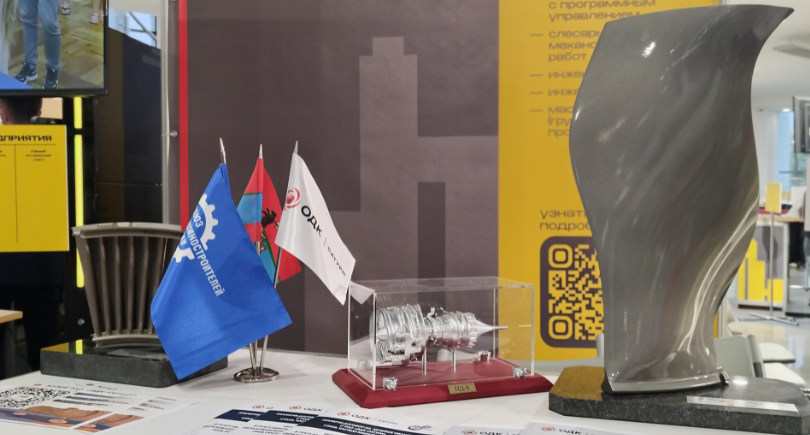

UEC-Saturn is showcasing key components of the PD-8 turbofan, highlighting the domestic manufacturing technologies and materials supporting the engine’s production and future lifecycle maintenance.
The United Engine Corporation is displaying a PD-8 engine model, a wide-chord fan blade and a low-pressure turbine nozzle sector at the Yaroslavl Region Industry Week, which runs from October 5 to 11, 2026.
The exhibits provide an insight into the manufacturing processes behind the 8-tonne-thrust engine, which powers the Superjet 100 and is also designed for the Be-200 amphibious aircraft.
From an MRO perspective, the technologies used to manufacture critical engine components are important to the long-term supportability of the PD-8. Domestic production of components, materials, and repair-related technologies can help establish a supply chain for replacement parts and future engine maintenance as the fleet accumulates operating hours.
PD-8 component manufacturing supports future engine sustainment
The low-pressure turbine nozzle sector is among the more complex components displayed by UEC-Saturn. Its castings use an equiaxed structure, with wall and edge thicknesses of up to 0.4 mm. The company says the use of newer domestic materials has improved component quality by 20%.
The manufacturing processes developed for the nozzle sector could support future production and replacement requirements as PD-8 engines enter service. Consistent manufacturing capability is particularly important for engine components subject to high temperatures and mechanical loads, where dimensional accuracy and material performance directly affect durability.
UEC-Saturn said its specialists developed new materials and production technologies as part of Russia’s import-substitution programme.
“As part of the import substitution program, UEC-Saturn specialists have carried out extensive work to develop and implement new materials and technologies. The components of the latest PD-8 engine presented at the inter-industry exhibition demonstrate the high technical level of domestic engine manufacturing. Addressing the large-scale challenges the state sets for UEC and Rostec State Corporation enterprises requires significant research and production potential, and the industry currently has it,” the company stated.
Another key component on display is the PD-8’s 3 kg titanium-alloy wide-chord fan blade, which measures 44.4 cm long and 22 cm wide.
The blade is manufactured using an isothermal stamping process developed by UEC-Saturn. A hydraulic press applies up to 4,000 tonnes of force at temperatures of up to 930°C, producing the required aerodynamic shape with a minimum allowance of 0.3 mm.
For engine maintenance organisations, manufacturing processes such as these are relevant to future component replacement, repair and overhaul capabilities. Establishing repeatable production methods for critical components can also reduce dependence on external supply chains and provide a foundation for lifecycle support.
PD-8 certification moves programme towards operational support
The PD-8 was developed by UEC-Saturn using domestically produced materials and manufacturing technologies. The engine received its type certificate in June 2026 at the St. Petersburg International Economic Forum, confirming compliance with applicable airworthiness requirements and standards.
Certification marks an important transition from engine development toward operational deployment, with maintenance infrastructure, spare-parts availability, technical documentation, and qualified personnel becoming increasingly important as the engine enters service.
The PD-8 is intended for the Superjet 100 short-haul aircraft and Be-200 amphibious aircraft, creating two potential applications for the engine and its associated component support ecosystem.
Also Read – Global Engine Maintenance India begins operations with CFM56 aftermarket capabilities
For operators and MRO providers, the availability of locally manufactured fan, turbine, and other engine components will be an important factor in supporting future shop visits and maintaining engine availability. Over time, the development of repair processes and component-level maintenance capabilities will also determine how efficiently the PD-8 can be supported through its service life.
The Yaroslavl exhibition therefore provides a view of more than the engine’s manufacturing technology. The components on display highlight the industrial base being developed around the PD-8 and the production capabilities that could underpin its future maintenance, repair, overhaul, and spare-parts support.