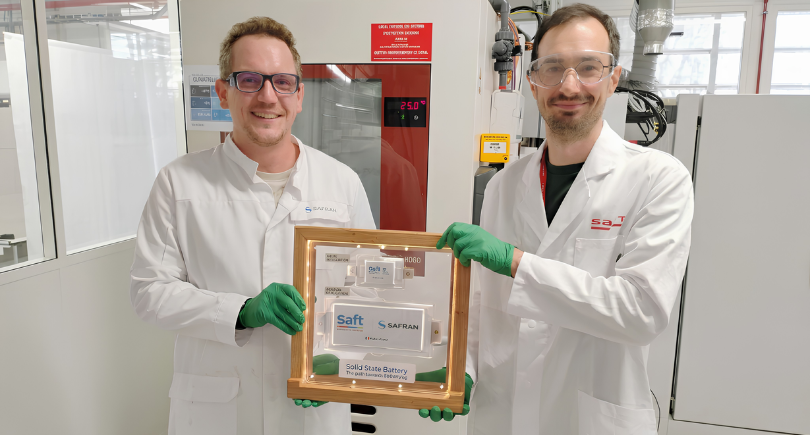

Safran and Saft have reached a new milestone in developing batteries for future electric and hybrid-electric aircraft, with the delivery of the first semi-solid battery cells for evaluation and validation.
The cells mark the transition from concept studies to practical testing under the companies’ partnership, announced at the 2025 Paris Air Show. The programme aims to develop high-performance energy storage solutions for future aeronautical applications and support efforts to reduce aviation emissions.
The cells were developed and manufactured on Saft’s multi-technology solid-state battery production lines in Bordeaux, France. Their delivery follows several years of investment, research and collaboration with European academic and industrial partners.
Testing and validation of next-generation batteries
Most of the delivered cells will be tested at Safran’s System Test Center in Niort, France. The facility will conduct much of the validation and integration work required to develop future battery systems for electric and hybrid-electric propulsion.
The testing phase will help assess the cells’ suitability for aviation applications and support the development of more advanced battery prototypes. For aircraft propulsion systems, battery performance, reliability, and integration are important considerations as manufacturers evaluate alternative power architectures.
From an engineering and MRO perspective, the development of aviation-specific battery systems also highlights the need to establish appropriate validation procedures and technical support capabilities. As these technologies mature, battery condition monitoring, system diagnostics, component replacement and lifecycle management could become increasingly relevant to operators and maintenance providers supporting electrically powered aircraft.
However, the current programme remains focused on technology evaluation and development rather than the introduction of a certified battery system into commercial service.
Also Read – Elbit Systems secures $270 mn contracts for ISR and targeting payloads
Solid-state technology roadmap
From 2027 onwards, the partnership is expected to expand to include solid-state cells and batteries, in line with the companies’ technology roadmap. The next stages will focus on evaluating the delivered cells, developing more advanced prototypes and maturing the technologies for future aeronautical applications.
The work forms part of the wider industry effort to develop energy storage systems capable of supporting new electric and hybrid-electric aircraft configurations. Battery technology is expected to play an important role in these designs, although further development and validation will be required before such systems can be deployed at scale.
The delivery of the first semi-solid cells gives Safran and Saft a practical basis for progressing their development programme. As testing advances, the results will help inform the design, integration and future support requirements of aviation battery systems.