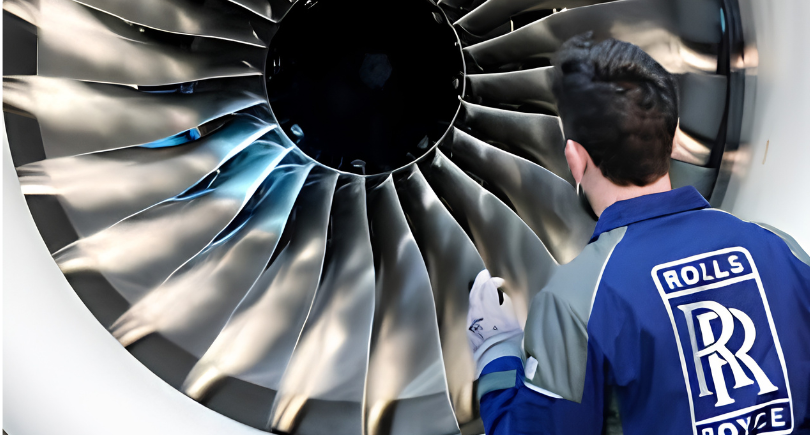

Rolls-Royce is currently actively evaluating the establishment of an aircraft engine MRO facility in India while simultaneously pursuing opportunities in military engine development, advanced manufacturing, and small modular nuclear reactors.
The proposed engine MRO facility would support Rolls-Royce-powered aircraft operating in the Indian market, particularly as Indian carriers rapidly expand their widebody fleets. The development comes at a time when both Air India and IndiGo have placed substantial orders for Airbus A350 aircraft, all powered exclusively by Rolls-Royce Trent engines.
Industry estimates indicate that the combined A350 order book of Indian airlines exceeds 100 aircraft, representing a future installed base of more than 220 engines, excluding spare engines. As these aircraft begin entering service in larger numbers over the coming years, the demand for localized engine maintenance capabilities is expected to grow significantly.
Currently, Rolls-Royce-powered commercial aircraft engines operating in India are largely supported through the company’s regional MRO network in Singapore and Hong Kong. Establishing an Indian engine MRO facility would reduce maintenance logistics, shorten turnaround times, improve fleet availability, and support the government’s broader objective of creating a self-reliant aviation maintenance ecosystem.
The move would represent a major milestone for India’s rapidly expanding MRO sector, which has increasingly attracted global OEMs seeking closer proximity to airline customers and growing aircraft fleets. With Indian airlines expected to induct hundreds of new aircraft over the next decade, engine maintenance capacity is emerging as one of the most critical segments of the aviation aftermarket.
Beyond civil aviation, Rolls-Royce is also positioning itself as a strategic partner in India’s defence aerospace ambitions. The company has proposed the establishment of an aero gas turbine complex in India that would support the development of advanced military jet engines while enabling future applications across both defence and civil aerospace programmes.
The proposal includes comprehensive technology transfer arrangements aimed at strengthening India’s indigenous propulsion capabilities. The initiative aligns closely with the country’s efforts to develop a domestically produced engine for the Advanced Medium Combat Aircraft (AMCA), India’s flagship fifth-generation fighter programme.
If approved, the planned facility would support the design, development, testing, and manufacturing of next-generation aero engines within India, contributing to the country’s long-term objective of achieving greater technological sovereignty in critical aerospace technologies.
The company’s ambitions in India extend beyond aviation and defence. Rolls-Royce is also exploring opportunities in the emerging small modular reactor (SMR) segment following recent policy reforms that have opened new avenues for private sector participation in India’s civil nuclear energy sector. The development could potentially create a new industrial vertical for the company in one of the world’s fastest-growing energy markets.
India’s importance within Rolls-Royce’s global strategy has continued to increase over recent years. The company already maintains a substantial footprint across civil aerospace, defence, power systems, marine propulsion, and industrial applications. Today, thousands of Rolls-Royce engines operate across India’s aviation, defence, naval, and energy sectors, supported by an expanding local supplier network and industrial partnerships.
The company currently sources hundreds of millions of dollars’ worth of components and services from India annually and has indicated that this figure could increase significantly over the next five years as aerospace manufacturing, defence programmes, and power-generation opportunities expand.
Rolls-Royce’s existing collaborations with Indian industry, including joint ventures and technology partnerships, have helped establish a growing engineering and manufacturing ecosystem supporting both domestic and global programmes. Future investments linked to engine development, MRO infrastructure, advanced manufacturing, and energy technologies could potentially generate substantial employment opportunities while accelerating capability development within India’s aerospace and defence supply chain.
For India’s aviation maintenance sector, the prospect of a dedicated Rolls-Royce engine MRO facility represents a particularly significant development. As airlines continue to induct new-generation widebody aircraft and expand international operations, localized engine support capabilities will become increasingly important in reducing maintenance costs, improving operational efficiency, and positioning India as a competitive regional MRO hub.
The potential investment also aligns with the government’s broader vision of transforming India from a large aviation market into a global centre for aerospace manufacturing, engineering, and aftermarket services. If realized, the project would mark another major step in strengthening the country’s position within the global aviation value chain while supporting the long-term growth of India’s commercial aviation and aerospace industries.