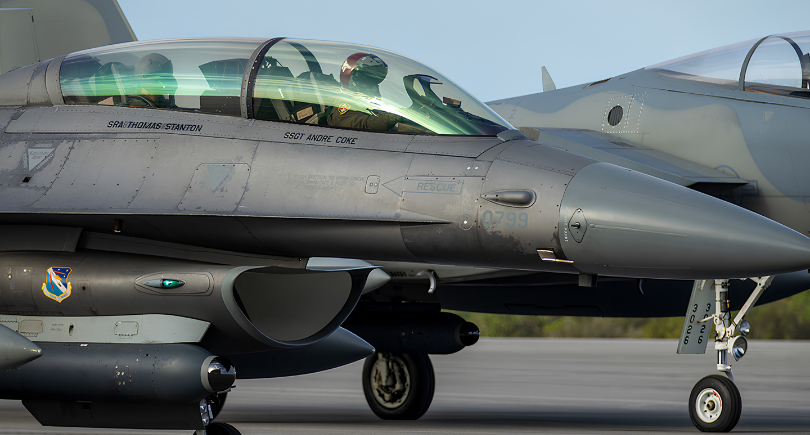

Lockheed Martin has completed flight testing of its Legion infrared search-and-track (IRST) sensor system with a new pod-to-pod data link on F-16 aircraft in Tucson, Arizona.
The recent tests involved two F-16s equipped with Legion sensor systems and a pre-production version of HiveLink, a data-link system developed by L3Harris. The aircraft operated from Morris Air National Guard Base and used the link to share sensor data between the pods.
The shared data improved track accuracy and enabled the aircraft to establish range information on multiple airborne targets using passive infrared sensing.
Legion, formerly known as IRST21, is a passive IRST system designed around a modular open architecture. The architecture allows additional capabilities, including data links and other mission-system technologies, to be integrated into the sensor system.
The latest flight tests were conducted with the Air National Guard and Air Force Reserve Test Center (AATC). Under an Air National Guard contract, Lockheed Martin is testing Legion on F-16 aircraft to evaluate performance, transportability, and interoperability.
“Working side by side with the Air National Guard and AATC, we are turning proven infrared search-and-track into a networked, passive capability that is ready now,” said Cristin Stengel, Program Director for Lockheed Martin Legion. “With Legion’s pod-to-pod data link and open architecture, we’re providing aircrews faster, more accurate targeting in the most contested airspaces.”
HiveLink provides line-of-sight and beyond-line-of-sight connectivity and incorporates mesh networking and Common Data Link interoperability. The system is designed to support integration on platforms with size, weight and power constraints.
For aircraft operators and maintenance organisations, integrating data links with existing podded sensors introduces additional requirements for software configuration, system integration, testing and interoperability validation.
Also Read – Royal Jordanian selects Ramco Systems to drive digital MRO transformation
Legion is currently fielded in podded form on F-15 and F-16 aircraft, with the architecture allowing the system to be adapted for additional aircraft platforms.
The system builds on Lockheed Martin‘s earlier IRST technology, which the company says has accumulated more than 300,000 flight hours on F-14 and F-15 aircraft. The latest testing adds pod-to-pod data sharing to the Legion system and provides further validation of its open-architecture approach.