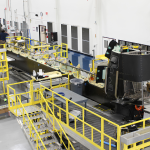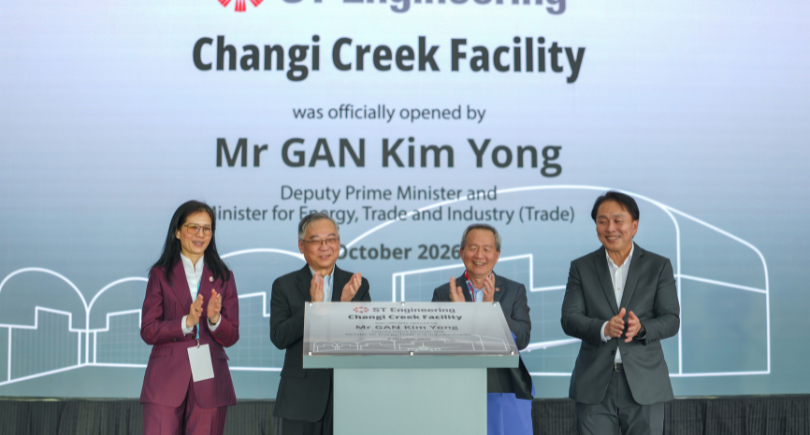

ST Engineering has opened a new commercial aerospace airframe maintenance, repair and overhaul (MRO) facility at Changi Creek, within Singapore’s Changi Airport, expanding its maintenance capacity to meet rising global demand for aircraft servicing.
The 84,000-square-metre facility is the company’s fourth airframe MRO site in Singapore. Once fully operational, its four widebody aircraft bays are expected to increase ST Engineering’s widebody airframe MRO capacity in Singapore by 40%, enabling the company to service approximately 100 additional widebody aircraft annually.
Singapore Deputy Prime Minister and Minister for Energy, Trade and Industry (Trade), Gan Kim Yong, attended the facility’s opening ceremony.
The expansion comes as airlines contend with growing fleets, extended aircraft service lives and increasing demand for maintenance slots. The new facility is expected to provide operators with greater access to maintenance capacity while strengthening ST Engineering’s global airframe MRO network.
Digitalisation and AI Drive Maintenance Operations
The new facility incorporates digital technologies, automation and artificial intelligence (AI) to improve maintenance planning, operational efficiency and aircraft turnaround times.
Its capabilities include digital planning systems, automated storage and retrieval solutions, robotics and electronic documentation rooms, providing greater visibility across maintenance activities and supporting data-driven decision-making.
Drones will be used for general visual inspections, while autonomous mobile robots will transport aircraft parts from storage areas directly to maintenance bays. These systems are designed to streamline workflows, reduce manual handling, and improve the movement of components across maintenance operations.
Real-time maintenance dashboards will provide operational insights to support faster decision-making. AI-enabled inspection and defect identification technologies are also expected to enhance maintenance quality, aircraft reliability and operational safety.
The facility incorporates sustainability measures, including on-site solar power generation and rainwater harvesting, as part of its design.
Also Read – Airbus expands Belfast wing facility for A220 growth
Workforce Expansion and Skills Development
ST Engineering expects the facility to employ more than 500 people when operations reach full capacity. The company will introduce training and upskilling programmes focused on digital technologies and AI-enabled maintenance processes to prepare employees for increasingly automated MRO operations.
Kevin Chow, President of Commercial Aerospace at ST Engineering, said the facility was developed to address airlines’ requirements for reliable maintenance capacity and consistent service quality as aircraft fleets expand and remain in service longer.
He added that the technology-enabled facility would reinforce Singapore’s position as a global aviation hub while supporting the development of advanced aerospace capabilities and skilled employment.
Cindy Koh, Executive Vice President at the Singapore Economic Development Board, said the facility would strengthen ST Engineering’s MRO capacity through advanced robotics, digitalisation and AI. She also highlighted the opportunities for Singapore’s workforce to develop new skills and pursue careers involving emerging aerospace technologies.
ST Engineering Expands Global MRO Network
Beyond Singapore, ST Engineering operates airframe MRO facilities in Guangzhou and Ezhou, China, as part of its Asia-Pacific network.
The company is also expanding its international maintenance footprint. A second hangar at its Ezhou facility is expected to become operational in the second half of 2027, while two new hangars in Pensacola, Florida, are scheduled to enter service progressively from early 2027.
These developments will further expand ST Engineering’s global airframe MRO capacity as airlines seek dependable maintenance support for growing fleets and ageing aircraft.
The new Changi Creek facility represents a significant addition to Singapore’s commercial aerospace infrastructure, combining increased widebody maintenance capacity with digitalisation, automation and AI-enabled processes to support the evolving requirements of the global aviation aftermarket.