
An industry spending the last three years rebuilding production momentum, the sight of one of the world’s largest cargo aircraft transporting commercial aircraft structures is more than just an operational decision; it is a reflection of the continuing fragility of the aerospace supply chain.
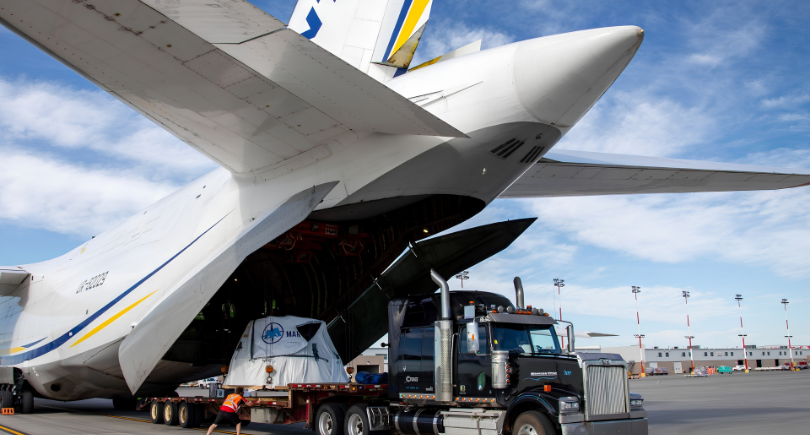
Recent reports indicate that both Airbus and Boeing have chartered the Antonov An-124 Ruslan, one of the world’s largest strategic airlifters, to transport oversized aircraft components that would traditionally move via sea or road. The move underscores the extraordinary measures manufacturers are taking to protect production schedules amid persistent supplier bottlenecks, logistics challenges and increasing pressure to deliver aircraft on time.
While air freight has always been an option for urgent aerospace shipments, using the Antonov An-124, a platform typically associated with military logistics, humanitarian relief and heavy industrial cargo highlights the strategic importance of maintaining uninterrupted production in today’s constrained manufacturing environment.
Supply chain pressure moves beyond parts shortages
The aerospace industry’s post-pandemic recovery has largely been defined by shortages of engines, castings, forgings, electronic components and skilled labour. However, the latest developments demonstrate that the challenge has evolved beyond component availability.
Today, manufacturers are increasingly grappling with logistical resilience ensuring that large aerostructures arrive at final assembly lines exactly when needed. Aircraft production follows an exceptionally synchronized manufacturing model. A delay in delivering a fuselage section, wing assembly or structural panel can halt an entire production line, creating cascading effects across suppliers, OEMs and airline customers.
Rather than allowing such delays to disrupt assembly schedules, Airbus and Boeing are now absorbing the significantly higher cost of strategic airlift to safeguard production continuity.
The decision reflects a broader industry trend where time has become more valuable than transportation cost.
Why the Antonov An-124?
The Antonov An-124 remains one of the few aircraft globally capable of transporting extremely large aerospace structures that exceed the capacity of conventional cargo aircraft. Its massive cargo hold enables manufacturers to move oversized fuselage sections, wing components and structural assemblies that would otherwise require lengthy sea or land transportation.
According to industry reports, Airbus recently utilized the aircraft to transport A350 structural components, while Boeing employed similar transport solutions for 767 fuselage sections supporting both its commercial freighter programme and the KC-46A Pegasus aerial refuelling tanker. These are shipments that would normally travel by ship or truck, but current production priorities have shifted the emphasis toward speed and schedule reliability.
Airbus’ integration challenge
For Airbus, the urgency appears closely linked to the integration of manufacturing facilities acquired from Spirit AeroSystems. The Kinston, North Carolina facility responsible for manufacturing central fuselage panels for the Airbus A350 programme is currently undergoing a complex transition following Airbus’ acquisition of Spirit’s Airbus-related operations.
Earlier this year, Airbus acknowledged delivery challenges associated with components originating from the facility. Although the company has indicated that progress is being made, executives have also recognised that integrating these operations into Airbus’ global industrial system will remain a multi-year undertaking.
To minimize further programme disruption, Airbus reportedly chose to airlift certain A350 structures rather than rely solely on ocean freight, providing additional logistical flexibility while maintaining production flow. The move illustrates how supply chain resilience increasingly depends not only on supplier capability but also on the speed with which manufacturers can adapt to unexpected disruptions.
Boeing faces parallel pressures
Boeing continues to face its own production balancing act. Industry reports suggest the company recently used an Antonov An-124 to transport upper fuselage sections for the Boeing 767 programme from Florida to Everett, Washington. The timing is significant.
The manufacturer must simultaneously support deliveries of the remaining 767-300 Freighters before production concludes while increasing output of the KC-46A Pegasus tanker programme for the US Air Force. Meeting both commercial and defence commitments leaves little room for logistical delays.
Rather than risk interruptions to final assembly, expedited air transport provides an insurance policy against increasingly unpredictable supply chain performance.
Supply chain resilience
The use of strategic airlift reflects a broader shift taking place across aerospace manufacturing. For decades, OEMs focused on lean inventory management and just-in-time production to reduce costs. Today’s environment demands a different philosophy.
Manufacturers are investing in greater inventory visibility, diversified suppliers, regional manufacturing capability and contingency logistics to ensure production continuity.
Strategic air freight has become one more tool within that resilience strategy.
Although significantly more expensive than sea transport, the financial impact of delayed aircraft deliveries, contractual penalties and production stoppages often outweighs transportation costs.
Also Read – DGCA clears Embraer E-Jets for India
The ripple effects extend well beyond aircraft manufacturing. For the MRO sector, production delays continue to influence fleet planning, spare parts availability and engine shop capacity. When new aircraft deliveries slip, airlines are forced to retain ageing fleets longer than planned, driving increased demand for heavy maintenance, structural repairs, engine overhauls and component support.
Supply chain instability therefore has a direct impact on MRO providers, who must manage higher workloads while navigating many of the same supplier constraints affecting OEMs. The growing reliance on strategic logistics also reinforces the importance of regional distribution hubs, predictive inventory management and digital supply chain visibility—areas that are becoming central to modern aftermarket operations.
Despite these challenges, both Airbus and Boeing remain committed to increasing production rates. Airbus is reportedly targeting approximately 900 aircraft deliveries in 2026, while Boeing continues its production recovery across multiple commercial programmes.
Achieving these ambitious goals will depend not only on manufacturing efficiency but also on the resilience of the global aerospace supply chain.
The recent deployment of the Antonov An-124 is therefore more than an isolated logistics decision, it is a clear signal that supply chain agility has become a strategic competitive advantage. As the aerospace industry transitions from recovery to sustained growth, the companies that succeed will be those capable of building supply networks that are not only efficient but also flexible enough to respond rapidly when disruption occurs.
For OEMs, suppliers and MRO providers alike, the lesson is increasingly evident, in today’s aerospace ecosystem, resilience is no longer a contingency plan it is a core operational capability.