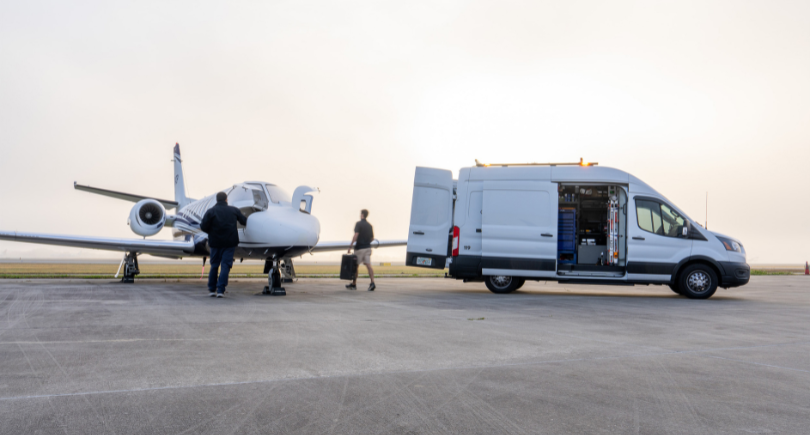

Textron Aviation has brought its Mobile Service Units (MSUs), Go Teams and 1CALL under a single leadership structure to improve coordination and access to OEM-backed maintenance support when aircraft are grounded away from service centres.
For business aircraft operators, an aircraft-on-ground (AOG) event can disrupt flight schedules, affect customer commitments and create unplanned maintenance costs. When an aircraft becomes unserviceable at an airport without dedicated maintenance facilities, the speed at which technical assistance reaches the aircraft can become a critical factor in its return to service.
Textron Aviation’s realignment of its mobile service network is intended to address this challenge by connecting customer calls, technical troubleshooting and field maintenance through a more coordinated support structure. The company has placed its MSUs, Go Teams and 1CALL under Seth Persons, general manager of the Mobile Service Network, with the stated aim of improving response coordination and access to the appropriate technical expertise.
The network supports Cessna, Beechcraft and Hawker aircraft, providing operators with access to technicians and OEM resources beyond the company’s fixed service locations.
Coordinating AOG calls with field maintenance response
An effective AOG response involves more than dispatching a technician. Maintenance teams must first establish the reported defect, identify the aircraft and system involved, assess the likely technical requirements, and determine what personnel, tooling, and parts may be needed at the aircraft’s location.
Textron Aviation’s 1CALL team provides the initial point of contact, while MSUs and Go Teams deliver mobile technical assistance and maintenance at the aircraft. Bringing these functions together under dedicated leadership is intended to improve coordination between the initial customer request and the field team responding to the problem.
This integrated approach can be particularly relevant when an aircraft is stranded away from its home base or an established maintenance facility. A coordinated response helps connect the reported fault with the technical resources required to investigate it, although the time needed to restore service will depend on the nature of the defect, parts availability, access to the aircraft and the maintenance actions required.
Textron Aviation’s mobile technicians have access to the manufacturer’s engineering resources, technical publications and wider service network. This OEM connection is important when troubleshooting requires aircraft-specific maintenance information or engineering guidance beyond the capabilities available locally.
The company says its network includes more than 50 MSUs and Go Teams positioned across its service network. These mobile resources allow technicians to travel to an aircraft rather than requiring every maintenance issue to be addressed at a fixed service centre.
OEM expertise at the aircraft’s location
Mobile maintenance support can help operators address selected faults and maintenance requirements without immediately arranging a ferry flight to a service facility. Depending on the aircraft condition and the work required, technicians may be able to troubleshoot the reported problem, carry out permitted maintenance and determine whether further work is necessary before the aircraft can return to service.
The distinction between troubleshooting and rectification is important in AOG situations. Some faults can be resolved through field maintenance, while others require specialist equipment, replacement components, additional inspections or more extensive workshop intervention. An effective support network must be able to identify these requirements and direct the aircraft towards the appropriate maintenance solution.
Access to OEM engineering and technical publications can also support fault isolation and ensure that maintenance is performed in accordance with applicable procedures. For operators of Cessna, Beechcraft and Hawker aircraft, this provides a link between field technicians and the manufacturer’s broader technical support capabilities.
Textron Aviation’s network realignment is designed to make that connection more seamless by bringing customer contact, mobile technicians and support resources under a unified structure. The company has identified customer feedback as a driver of the change, with the stated objective of delivering a more timely and coordinated response.
Reducing disruption through a connected support network
AOG events create operational pressure because aircraft downtime can affect subsequent flights, crew schedules and passenger commitments. The maintenance response must therefore balance speed with accurate diagnosis, procedural compliance and the availability of the resources needed to complete the work.
A mobile service network provides one route to addressing these challenges, particularly where the aircraft can be maintained at its current location. However, mobile support is not a substitute for every type of maintenance facility. Complex structural repairs, major component work and maintenance requiring specialised infrastructure may still necessitate recovery to an appropriately equipped service centre.
The value of a coordinated OEM-backed network lies in connecting these different stages of the response. Initial reporting, technical assessment, field intervention and escalation to additional maintenance resources can be managed as parts of the same support process rather than as separate interactions.
By placing 1CALL, MSUs and Go Teams under dedicated leadership, Textron Aviation is seeking to strengthen that coordination across its mobile service operation. The realignment does not itself establish new response-time commitments or guarantee that every AOG event can be resolved on site. Its significance is the effort to simplify access to OEM expertise and bring the relevant technical resources together when aircraft operators need support away from a service centre.
As business aviation operators continue to depend on aircraft availability and schedule reliability, coordinated AOG support remains an important part of the wider MRO ecosystem. Textron Aviation’s approach places mobile maintenance and technical assistance at the centre of its effort to help customers manage unplanned aircraft downtime.