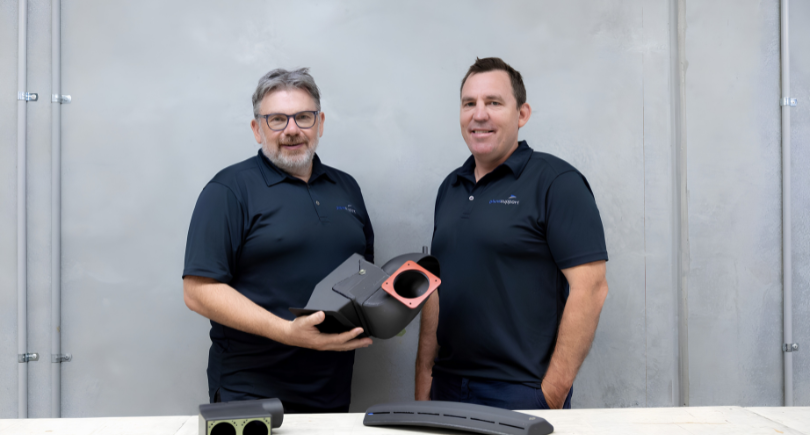

Plane Support has received Australian aviation regulator CASA’s approval to manufacture cabin air-conditioning ducting for the Bell 214B helicopter using additive manufacturing, opening a new route for producing replacement parts for an aircraft with challenging component-sourcing requirements.
The approval was granted under CASA’s Australian Parts Manufacturer Approval (APMA) framework and covers ducting components for the 214B (B-1). The project was initiated by McDermott Aviation, the world’s largest operator of the 214B and holder of the aircraft’s Type Certificate, to improve replacement-part availability for its fleet.
The two companies spent almost two years developing the components and working with CASA to establish the engineering, manufacturing and inspection processes required for approval. The project also expands Plane Support’s additive manufacturing capability under CASA Part 21K.
Reverse engineering establishes a route for replacement parts
Plane Support used 3D scanning to capture the geometry of original 214B ducting and create digital models. The components were then reverse-engineered and redesigned for additive manufacturing while retaining their original form, fit, and function.
To support production, Plane Support established a dedicated aerospace additive manufacturing laboratory equipped with the Markforged FX10 industrial 3D printing platform. The company also developed production controls, quality systems, and inspection procedures to demonstrate compliance with the applicable airworthiness requirements.
For helicopter operators and maintenance providers, the ability to manufacture approved replacement components can help address supply constraints when conventional sourcing routes are limited. Parts availability is particularly important for older aircraft types, where individual components may be difficult to obtain and prolonged waits can affect aircraft availability.
McDermott Aviation Founder and President John McDermott said the project was driven by the operational impact of unavailable parts.
“An aircraft waiting on a component you can’t easily get hold of is an aircraft that isn’t working,” McDermott said. “Being able to have approved parts made here in Queensland gives us far more control over that.”
Approval creates a pathway for further aerospace applications
The project required Plane Support to develop and validate its manufacturing processes from the ground up. The geometry of the ducting presented particular challenges, requiring the company to demonstrate that additively manufactured parts would fit correctly and perform as intended in the aircraft.
Plane Support Director of Engineering Jason Hazell said the work established procedures that could support future component development.
“Ducting sounds simple until you try to reproduce it. These are complex shapes that have to fit exactly and perform in the aircraft just as the originals do, and we had to prove every step of that to CASA,” Hazell said.
“We didn’t have an established process to follow, so we developed our own procedures, quality systems and inspection methods and worked them through with CASA. That groundwork now gives us a pathway for other components and other aircraft types.”
For McDermott Aviation, the initiative also supports its responsibility to maintain the long-term viability of the 214B as Type Certificate holder. The collaboration combines McDermott’s operational and maintenance experience with Plane Support’s engineering, manufacturing, and regulatory expertise.
The approval demonstrates how additive manufacturing can be applied to specific aircraft replacement-part requirements within an established airworthiness framework. Further applications will depend on component-level engineering, validation, and regulatory approval, but the project provides a basis for exploring the technology across additional parts and aircraft platforms.