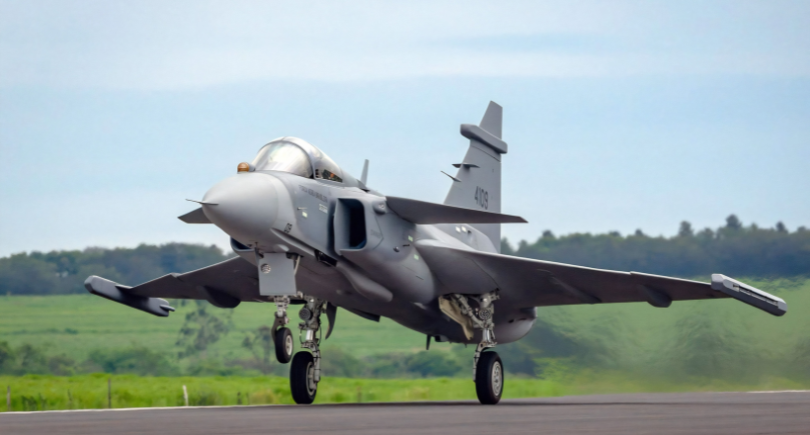

The first Gripen E fighter produced in Brazil by Embraer has completed its maiden flight, marking a significant milestone in Brazil’s effort to build indigenous capability in advanced fighter aircraft manufacturing, integration and testing.
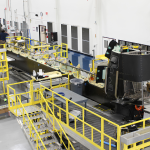
The aircraft took off from Embraer’s industrial complex in Gavião Peixoto, São Paulo, on a flight designed to verify the performance of its main systems and validate its flight characteristics. Conducted by a Saab test pilot, the flight generated data that will support the aircraft’s production flight-test and acceptance campaign ahead of delivery to the Brazilian Air Force.
More importantly, the milestone demonstrates how Brazil’s Gripen programme has evolved beyond aircraft procurement into a long-term industrial capability-building initiative.
From Fighter Acquisition to Industrial Capability
Brazil’s Gripen programme was structured around technology transfer, local industrial participation and the development of national aerospace and defence competencies. More than a decade after the programme began, that strategy is now translating into an established Brazilian capability to manufacture, integrate and test a next-generation fighter.
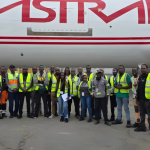
Embraer played a central role in planning and executing the maiden flight, highlighting the maturity of the capabilities developed through its cooperation with Saab and the Brazilian Air Force.
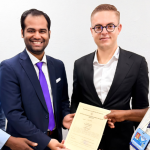
“This first flight of a Gripen E produced in Brazil by Embraer is a historic milestone for the country’s aerospace and defense industry,” said Bosco da Costa Junior, President & CEO of Embraer Defense & Security.
He said the achievement demonstrates that the competencies developed through the programme have evolved into proven industrial capabilities, strengthening Brazil’s defence industrial base and its ability to participate in complex global defence programmes.
For Brazil, that distinction is important. Building a fighter locally is not simply about assembling an aircraft. It requires expertise across engineering, manufacturing, systems integration, testing, certification and sustainment capabilities that can support the wider aerospace and defence ecosystem over decades.
Brazil becomes a second Gripen production hub
The Gavião Peixoto facility now hosts the only Gripen production line outside Sweden, giving Brazil a strategic position within Saab’s global manufacturing and supply network. The aircraft that completed its maiden flight is the first of 15 Gripen aircraft planned for production in Brazil under the current programme.
Following the production flight-test and acceptance campaign, the aircraft will be prepared for delivery to the Brazilian Air Force. It will then be transferred to Anápolis Air Base in Goiás, where it will join the First Air Defense Group, which already operates the Gripen E.
Saab’s Marcus Wandt, Head of Business Area Aeronautics, said the maiden flight demonstrated that Gripen production in Brazil had reached a new level of maturity and created a strong foundation for the fighter’s future development in the country.
Technology transfer at the core
The Brazilian Gripen programme began with a 2014 contract covering 36 aircraft — 28 single-seat Gripen E fighters and eight two-seat Gripen F aircraft. Deliveries began in 2020, with 10 aircraft delivered to the Brazilian Air Force to date. However, the programme’s significance extends well beyond the number of aircraft ordered.
Its technology-transfer and industrial-cooperation programme has involved Brazilian engineers, technicians and specialists working alongside Saab teams across development, engineering, manufacturing, integration and flight testing. Over time, transferred knowledge has been converted into permanent industrial capabilities within Brazil.
That is perhaps the most important outcome of the programme. A successful technology-transfer programme is ultimately measured not simply by the knowledge received, but by whether that knowledge becomes embedded in local companies, people, infrastructure and production systems.
The first Brazil-produced Gripen E taking flight provides a tangible demonstration of that transition.

Cooperation could expand further
The industrial relationship between Embraer and Saab could also become more important in the years ahead. In July, the two companies signed a Heads of Agreement establishing a framework for expanding their cooperation and continuing negotiations towards new contracts.
The agreement contemplates the potential production of 20 additional Gripen aircraft, with scope for further expansion, at Embraer’s Gavião Peixoto facility for Brazilian and international opportunities. If realised, the arrangement could allow Brazil’s production capability to complement Saab’s final assembly line in Linköping, Sweden.
That would give Saab greater flexibility in responding to future Gripen demand while further integrating Brazilian industry into the fighter’s global production network.
Brazil’s Defence Industry
The Gripen programme illustrates a broader shift in how countries are approaching modern fighter acquisition. For emerging aerospace powers, buying aircraft provides an immediate operational capability. But building the industrial ecosystem behind those aircraft can deliver a much longer-term strategic return. Brazil’s experience shows the potential value of linking a fighter acquisition with engineering development, workforce training, manufacturing, systems integration and testing.
The result is not just a fleet of combat aircraft. It is a domestic industrial base capable of supporting increasingly complex aerospace programmes. For Embraer, meanwhile, the milestone strengthens its position in the global defence aerospace sector by demonstrating its ability to contribute to the production and testing of a sophisticated fighter aircraft.
The first Brazilian-built Gripen E therefore represents more than the first flight of another aircraft. It is a demonstration of what sustained technology transfer, industrial cooperation and long-term planning can achieve, turning a fighter procurement programme into a foundation for national aerospace capability.