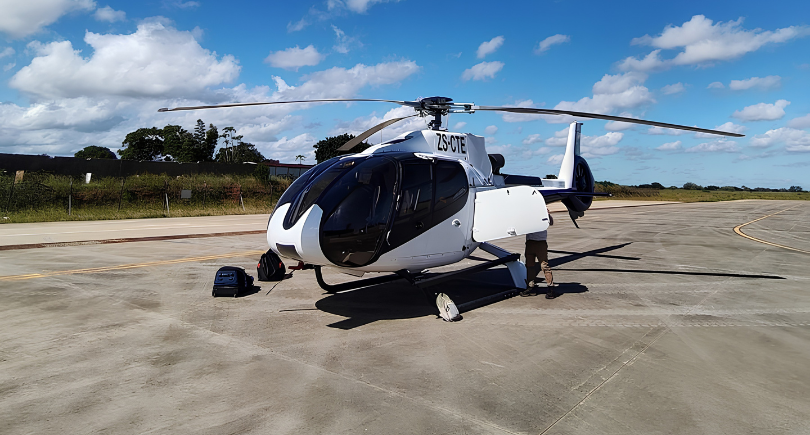

BAC Helicopters used an Airbus H130 to deliver food and supplies to communities isolated by flooding in Mozambique during a two-week relief mission.
Mozambique experienced severe flooding in early 2026, damaging roads and bridges and leaving communities in Gaza province inaccessible by land. BAC Helicopters deployed an H130 to support relief operations coordinated by the Airbus Foundation and the World Food Programme (WFP).
The mission began on 4 February 2026, when BAC Helicopters received a request from the Airbus Foundation. Pilot Frasier Cilliers flew the H130 to Gaza province and remained on site throughout the operation, conducting repeated supply flights from the regional airport at Xai-xai.
The H130 was configured for cargo operations by removing the rear passenger seats and using the cabin for supplies. Its 2,500 kg maximum takeoff weight allowed the aircraft to carry repeated loads to remote landing zones.
The operation required careful weight and balance calculations for every flight. Cargo weight determined the amount of fuel that could be carried, with the crew balancing payload and fuel requirements to maximise the number of deliveries possible each day.
The aircraft operated with quick turnarounds, with ground crews preparing subsequent loads while the H130 returned from remote landing zones. Afternoon thunderstorms during the rainy season were also monitored as part of the daily flight planning.
Landing-site selection was another operational consideration. Before the first landing at a location, Cilliers conducted an aerial reconnaissance to identify suitable areas of dry and relatively level ground.
“There were a couple times where Frasier decided to land slightly away from where they’d discussed with the WFP, because it was flatter or the grass was shorter or it had less dust,” said Greg Strydom, Flight Safety Security Manager at BAC Helicopters.
The H130’s wrap-around windows provided visibility during reconnaissance and approach, while its compact size supported operations from improvised landing areas.
Ground teams were trained on aircraft safety and unloading procedures before operations began. Personnel were instructed not to approach the helicopter until the engines had been shut down, although some loads were handled with the rotors turning when the next drop location was close enough to reduce turnaround time.
“One of the dangers in these kinds of missions is that because there’s always a large number of people waiting, they tend to rush to the helicopter. The tail rotor can be quite a danger, but luckily the H130 has got a Fenestron, so that mitigates the risk,” Strydom said.
The helicopter’s wide cabin, enclosed Fenestron tail rotor and compact dimensions supported the repeated cargo flights during the relief operation.
Also Read – Romanian Ministry of Internal Affairs places order for 12 Airbus helicopters
“If the next drop was close enough, they would do everything while the blades were turning,” Strydom added. “They’d just load and get as much delivered as possible.”
The mission demonstrates how light helicopters can support humanitarian logistics when conventional ground transport is disrupted, with payload planning, aircraft configuration, weather monitoring, and landing-site assessment forming key parts of the operation.