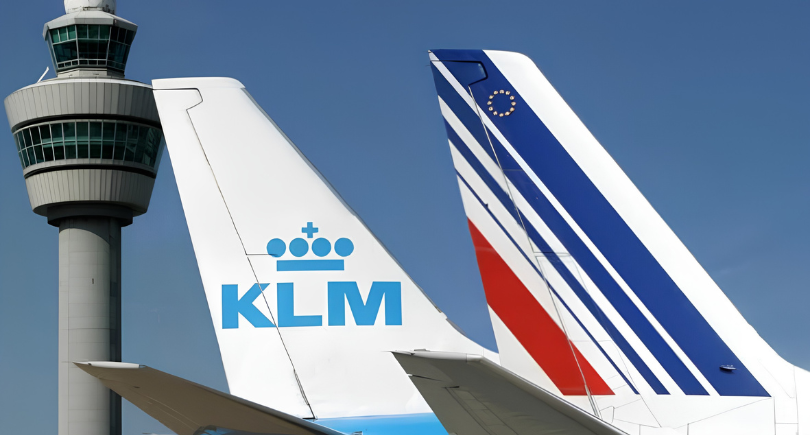

Air France-KLM’s aircraft maintenance business forms part of a wider European economic footprint estimated at nearly €114 billion annually, with the Group servicing more than 3,000 aircraft for around 200 airline customers in addition to maintaining its own fleet.
The findings come from the Group’s latest socio-economic impact study, which measures its contribution across the European Union for the first time. Conducted under the direction of Professor Herbert Castéran, Director of Institut Mines-Télécom Business School, the study examines the economic effects of the Group’s passenger, cargo and aircraft maintenance activities.
In 2025, Air France-KLM carried 103 million passengers and transported 917,000 tonnes of freight. Its maintenance business also provided services to external airline customers, placing aircraft maintenance alongside passenger and cargo operations as one of the Group’s three main business activities.
The study estimates that Air France-KLM’s activities generate nearly €114 billion in annual economic benefits across the EU, equivalent to 0.6% of the bloc’s GDP, and support more than 1.2 million direct, indirect and induced full-time equivalent jobs. These figures cover the Group’s overall economic impact and are not attributed to the maintenance business alone.
France and the Netherlands account for the largest shares of the Group’s reported economic footprint. In France, the annual contribution is estimated at €52.2 billion, supporting nearly 550,000 full-time equivalent jobs. In the Netherlands, the estimated contribution is €29.1 billion, supporting almost 300,000 jobs.
The study also highlights the importance of the Île-de-France region, where Air France operates its main hub at Paris-Charles de Gaulle and maintains a significant technical presence. The Group’s activities generate an estimated €27.2 billion in annual economic benefits in the region, equivalent to 3.1% of its GDP. The release specifically identifies major maintenance facilities at Paris-Orly, including facilities supporting latest-generation engines.
For the MRO sector, the figures underline the scale of maintenance activity within an integrated airline group that also serves third-party operators. Providing maintenance to external customers extends the business beyond the technical requirements of the Group’s own fleet and connects its facilities, workforce and suppliers to the wider airline market.
Air France-KLM’s maintenance operations form part of a supply chain involving skilled technical personnel, component and equipment suppliers, engineering services and specialist facilities. The study’s broader methodology considers economic effects arising from employee spending, supplier purchases, passenger expenditure, taxation and airport activity, but does not separately quantify the maintenance business’s contribution to these totals.
The Group’s workforce reached 80,000 in 2025, following the recruitment of 3,000 employees during the year. While the study does not provide a separate headcount for maintenance personnel, the wider employment findings reflect the scale of the organisation supporting its passenger, cargo and technical operations.
The report provides an EU-wide view of Air France-KLM’s economic footprint as the Group pursues further expansion across Europe. For aircraft maintenance, its significance lies in the scale of the existing operation: more than 3,000 aircraft serviced for 200 external airline customers, alongside the maintenance requirements of the Group’s own fleet.