
Lufthansa Technik on Biomimetic Innovation, Aerodynamic Efficiency and the Path to Decarbonisation
As the global aviation industry intensifies its efforts to achieve net-zero carbon emissions by 2050, airlines and MRO providers are increasingly turning toward innovative engineering solutions that can deliver immediate and scalable sustainability benefits. Among the most promising developments in this space is AeroSHARK, the sharkskin-inspired aerodynamic surface technology jointly developed by Lufthansa Technik and BASF, designed to reduce drag, lower fuel burn and cut CO₂ emissions across commercial aircraft fleets.
What began as a breakthrough fuselage application is now evolving into a far more comprehensive aerodynamic efficiency solution, with Lufthansa Technik and Airbus expanding AeroSHARK deployment to the wings and stabilizers of the Airbus A330ceo. The development represents a significant milestone not only in aircraft engineering and certification, but also in the aviation industry’s broader decarbonisation journey.
In this exclusive interaction with MRO Business Today, Lufthansa Technik discusses the science behind AeroSHARK, the operational results already being achieved by airlines, the growing role of biomimetic engineering in aviation, and how aerodynamic innovation, advanced materials and MRO-led sustainability solutions are expected to shape the future of greener aviation operations.
1 – AeroSHARK has emerged as one of the most innovative sustainability solutions currently available for commercial aviation. Could you explain how the technology contributes toward reducing fuel burn and CO₂ emissions for airline operators?
Ans – AeroSHARK is based on a bionic surface technology jointly developed by Lufthansa Technik and BASF. The adhesive film applied to the aircraft fuselage features microscopic structures known as riblets, inspired by the texture of shark skin. These riblets are designed to optimize the airflow along the aircraft’s surface. By guiding the air more smoothly in the direction of flight and reducing disruptive crossflow as well as turbulence-induced friction, they significantly lower the aerodynamic drag acting on the aircraft.
The impact of this is straightforward but powerful: an aircraft that encounters less aerodynamic resistance requires less engine thrust to maintain the same speed and altitude. As a result, fuel consumption on a given route is reduced. And since fuel burn is directly linked to emissions, this translates into a measurable reduction in CO₂ output for airline operators.
In essence, AeroSHARK improves the aerodynamic efficiency of existing aircraft without requiring major structural changes. This makes it a highly attractive and scalable solution for airlines aiming to lower both operating costs and environmental impact at the same time.
2 – Lufthansa Technik and Airbus are now extending AeroSHARK application to the Airbus A330ceo wings and stabilizers. What makes this development particularly significant from both an engineering and sustainability perspective?
Ans – Extending AeroSHARK to the wings and stabilizers of the Airbus A330ceo marks a major step forward – both technically and in terms of sustainability impact. From an engineering perspective, wings and tailplanes are the most aerodynamically sensitive parts of an aircraft. They are critical for generating lift and ensuring precise control in flight. Any modification to these surfaces is therefore significantly more complex than applying solutions to the fuselage, as it must meet the highest safety and certification standards without compromising flight performance. This is where the combined expertise of Lufthansa Technik and Airbus becomes decisive: Lufthansa Technik brings years of experience in aerodynamic optimization and riblet technology, while Airbus contributes its deep, original design knowledge of the aircraft platform. Together, this enables the safe integration of an innovative surface technology onto the most critical aerodynamic surfaces while maintaining the same level of safety passengers expect today.
At the same time, the sustainability impact is particularly significant. Because wings and stabilizers play such a dominant role in the aircraft’s aerodynamic performance, even small improvements in drag reduction translate into disproportionately large efficiency gains. In fact, applying riblet technology to these areas delivers higher aerodynamic efficiency per surface area compared to the fuselage. This means that similar savings can be achieved with a comparatively smaller treated area.
When combined across the full aircraft fuselage, engines, wings, and tailplane – the overall effect becomes substantial. The integrated AeroSHARK concept is expected to deliver fuel and CO₂ savings on the order of around 2.5% per aircraft, demonstrating how incremental aerodynamic improvements can scale into meaningful emissions reductions at fleet level.
In essence, the move to wings and stabilizers transforms AeroSHARK from a highly effective retrofit solution into a more holistic aerodynamic efficiency package unlocking the next level of sustainable performance in commercial aviation.
3. The aviation industry is under increasing pressure to meet net-zero carbon emission targets by 2050. In your view, how important will aerodynamic surface technologies such as AeroSHARK become in helping airlines achieve these sustainability goals?
Ans – Aerodynamic surface technologies such as AeroSHARK are expected to play a meaningful – though not exclusive- role in helping the aviation industry move toward its net-zero ambitions.
Looking ahead, it is widely acknowledged that conventional aircraft designs will remain in service well beyond 2050. While these platforms have already undergone decades of aerodynamic optimization, the remaining potential for further efficiency gains through traditional design changes is limited. This is precisely where technologies like AeroSHARK come into play: they enable incremental yet highly relevant efficiency improvements without requiring fundamentally new aircraft architectures.
By enhancing the aerodynamic performance of existing designs, AeroSHARK makes it possible to reduce fuel burn and CO₂ emissions across today’s global fleet. Even relatively small percentage gains become highly impactful when applied at scale, particularly important given the long service life of commercial aircraft. Importantly, this approach is not limited to current aircraft configurations. Even if future Concepts, such as blended wing body aircraft enter service, the underlying principle remains valid: optimizing the aircraft’s surface to reduce drag will continue to be a key
lever for improving efficiency. In that sense, AeroSHARK represents a technology platform that can evolve alongside future aircraft designs. At the same time, it is clear that no single solution will be sufficient to achieve climate neutrality in aviation. AeroSHARK alone will not deliver net-zero emissions. However, it can make a substantial contribution as part of a broader toolbox that includes sustainable aviation fuels, operational improvements, and next-generation propulsion technologies. In parallel, ongoing advances in computational methods and aerodynamic modeling are expected to unlock further optimization potential in the future. While many of these concepts are still under development, they underline a key point: aerodynamic innovation is far from exhausted and will remain an important pillar in the industry’s long-term decarbonization strategy.
In essence, technologies like AeroSHARK help bridge the gap between today’s fleet and tomorrow’s aviation concepts, delivering immediate, scalable emissions reductions while paving the way for continued aerodynamic innovation.
4. AeroSHARK is inspired by the microscopic structure of sharkskin. Could you elaborate on how biomimetic engineering is influencing the future of aircraft efficiency and sustainable aviation innovation?
Ans – Biomimetic engineering, learning from nature, is increasingly influencing aircraft efficiency, and AeroSHARK is a clear example of this shift. While the principle of sharkskin-inspired riblets has been known for decades, the real breakthrough was making it industrially scalable. Lufthansa Technik and BASF Coatings have succeeded in turning a natural concept into a certifiable, large-scale solution that reduces aerodynamic drag and improves efficiency.
Looking ahead, nature still offers further inspiration, especially beyond aerodynamics. In particular, structural design and lightweight construction hold significant potential, although current manufacturing limits what can be realized today.
In essence, AeroSHARK demonstrates that biomimetic ideas are moving from theory into practice – opening the door for future innovations that could further enhance efficiency and sustainability in aviation.
5. Lufthansa Technik has stated that fully modified AeroSHARK-equipped aircraft can achieve fuel savings exceeding two percent on long-haul operations. Could you share some real-world operational insights or customer feedback from airlines currently using the technology?
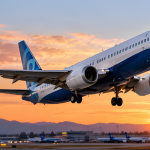
Ans – To date, large-scale AeroSHARK modifications have been applied to 30 Boeing 777 aircraft of several airlines and one Lufthansa Boeing 747, which served as a testbed. The number is steadily growing, demonstrating the riblet film’s efficiency in daily operations. As of April 2026, AeroSHARK-modified aircraft have accumulated over 350,000 flight hours, saving more than 20,600 metric tons of jet fuel and reducing CO₂ emissions by over 65,000 metric tons.
At this stage, Lufthansa Technik’s assessment is primarily based on operational data provided by airline customers using the current AeroSHARK configuration on fuselage and engine nacelles. These analyses consistently confirm the expected performance, showing fuel savings of up to around one percent, depending on the specific flight profiles and operating conditions. While the detailed datasets remain proprietary and cannot be disclosed, the overall trend is clear: the technology delivers the efficiency improvements it promises in real-world operations.
Beyond internal evaluations, several airlines have also publicly shared their experience. Austrian Airlines, for example, recently reported that after one year of operating AeroSHARK on four aircraft, it has already saved more than 900 tons of fuel, demonstrating the tangible impact at the fleet level.
Similarly, LATAM Airlines has highlighted the performance of AeroSHARK in public communications, with its leadership confirming that the technology is delivering the expected results in daily operations. Taken together, these insights underline a key point: AeroSHARK is not just a theoretical concept, but a proven solution already generating measurable fuel and CO₂ savings under real airline conditions, building confidence as the technology continues to evolve toward even greater efficiency gains.
6. From a certification and MRO standpoint, what are some of the biggest technical and operational challenges involved in expanding AeroSHARK applications to additional aircraft surfaces and platforms?
Ans – From a certification and MRO perspective, expanding AeroSHARK to new aircraft surfaces and platforms remains a highly complex undertaking, primarily driven by the depth of engineering work required.
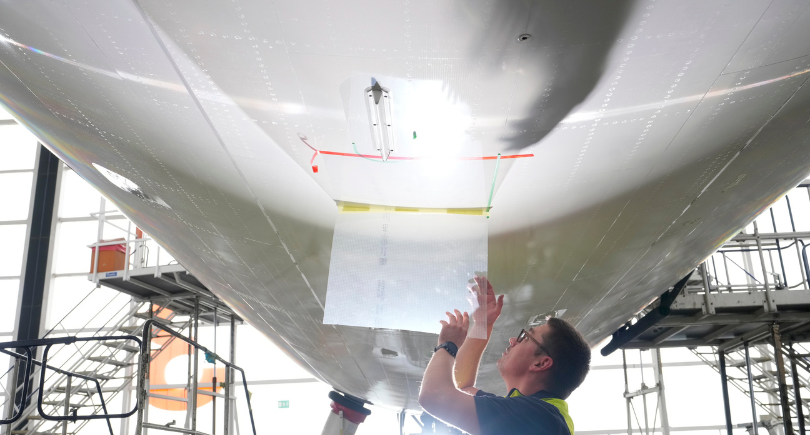
One of the biggest challenges lies in certification. For each aircraft type, Lufthansa Technik effectively needs to rebuild a detailed aerodynamic understanding of the entire aircraft, as this level of data is not available. This includes not only analyzing the baseline aerodynamics, but also translating optimized flow behavior into a practical application concept defining precisely how thousands of individual riblet film pieces must be positioned and oriented on the aircraft surface.
In practice, this resembles a highly sophisticated “puzzle” with close to 2,000 individual elements, which must be newly designed and optimized for every aircraft platform. Applying AeroSHARK requires a level of precision and process discipline that goes far beyond traditional aircraft maintenance tasks. Until recently, most MRO providers had little or no experience with such surface technologies. Even something as seemingly simple as applying a single riblet patch demands exact positioning and orientation to ensure the intended aerodynamic effect, requiring new skills, tools, and quality assurance processes.
However, this is also where experience becomes a key enabler. Lufthansa Technik has built up significant know-how through existing AeroSHARK programs and can transfer this expertise directly to MRO partners through targeted training and standardized procedures. Once these skills are established, the transfer to additional aircraft types becomes significantly more straightforward, allowing the technology to scale across fleets more efficiently: The installation is delivered as a tailored kit, following a well-established application process similar to other placards. It runs in parallel with planned base maintenance layovers, requiring no extra downtime. MROs worldwide can perform the installation, supported by our certified training and quality assurance, so the operator chooses the facility and crew. Lufthansa Technik provides supervision and planning to ensure a smooth experience.
7. Sustainability is increasingly becoming a central focus within the global MRO industry. How does Lufthansa Technik see the role of aircraft modification, advanced materials and engineering-led innovation evolving over the next decade in supporting greener aviation operations?
Ans – Sustainability as a focus topic in MRO goes of course beyond aircraft modification, advanced materials and engineering, the environmental impact of MRO operations such as the use of renewable energy, the reduction of hazardous waste and the recycling of non-hazardous waste are also key focus areas, driven not just by the need to become more sustainable and ultimately reach net zero targets, but also to meet stricter legislative requirements particularly driven by the EU. With respect to aircraft modification, advanced materials and engineering innovation, we believe there are several areas where performance improvements can be made on existing aircraft. Using advanced data analytics, aerodynamic simulation as well as the application of advanced materials, we believe that significant results can be achieved in the areas of aerodynamic performance, engine efficiency and weight reduction.
At the same time, a close integration of disciplines, including Digital Tech Ops, OEM and MRO capabilities, and airline operators, enables the development of tailored solutions that can unlock substantial sustainability potential. This interdisciplinary collaboration is essential to identifying and implementing measures that are both technically effective and operationally viable.
Moreover, today’s new fleets will become tomorrow’s in-service fleets. Ensuring that these aircraft maintain their performance and efficiency over time will therefore remain an increasingly important priority. In this context, sustaining and enhancing operational efficiency throughout the lifecycle of an aircraft will be a critical factor in achieving long-term sustainability goals.
8. As AeroSHARK continues to expand across more aircraft types, what can the industry expect next from Lufthansa Technik in terms of sustainable aircraft technologies and future decarbonization initiatives?
Ans – In 2023, Lufthansa Technik set up an Aerolutions Lab with the goal of identifying and accelerating efficiency opportunities across aerodynamics, aircraft data analytics, and future cabin products, using a combination of structured idea evaluation, cross-functional expert collaboration, and rapid prototyping to move fast and focus on what creates real value both from a monetary and sustainability standpoint. The Aerolutions LAB focuses on the most effective sustainability levers and utilizes diverse capabilities of our Group to transform high-impact ideas into end-to-end maintenance and retrofit solutions in the areas of Aerodynamics, Engine Efficiency, and Weight reduction. The resulting software and hardware solutions will form the foundation of our future efficiency improvement offering, enabling airlines to achieve significant CO₂ savings.