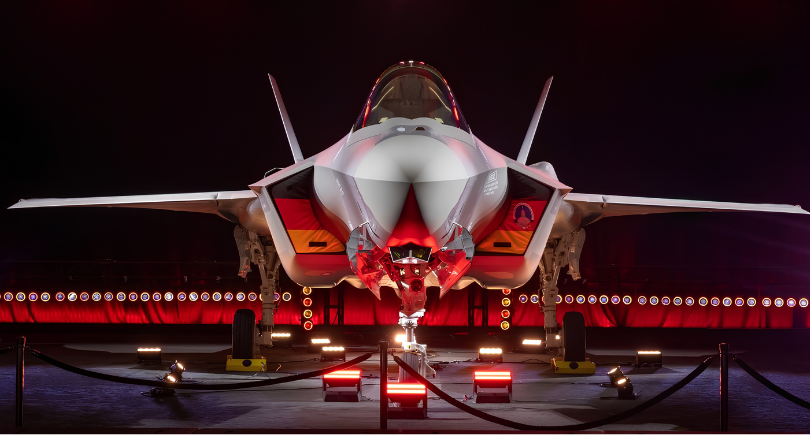

Lockheed Martin has presented Germany with its first F-35A Lightning II, marking a major milestone in the country’s transition to fifth-generation fighter capability and opening a new chapter for Germany’s military aviation, training and sustainment ecosystem.
Germany’s first F-35A was formally presented to the German government during a ceremony at Lockheed Martin’s F-35 production facility in Fort Worth, Texas, on September 18, bringing the country closer to introducing the fifth-generation fighter into Luftwaffe operations.
Senior German and US government and military officials, alongside Lockheed Martin employees and industry partners, attended the ceremony, which highlighted the growing integration of Germany into the multinational F-35 programme and the wider NATO fighter ecosystem.
Germany has committed to acquiring 35 F-35A aircraft, with the first eight aircraft scheduled to be delivered to Ebbing Air National Guard Base in Arkansas beginning this fall for German pilot training. The first German F-35s are expected to arrive in Germany in late 2027, while full operational capability is planned for 2029.
From aircraft delivery to a new sustainment ecosystem
For Germany, the F-35 programme represents more than the introduction of a new fighter platform. It also involves the development of the infrastructure, training, maintenance and industrial capabilities required to support a sophisticated fifth-generation fleet over its operational life.
German industry has been involved in the F-35 programme since its inception in 2001 and is expected to continue playing a role in the programme’s global industrial and supply chain network.
Lockheed Martin said it is exploring additional industrial participation opportunities with German companies, including areas spanning manufacturing, sustainment, training, research and development.
This industrial participation could become increasingly significant as Germany prepares for the long-term operation and maintenance of its F-35 fleet. The introduction of the aircraft will require specialised technical skills, maintenance infrastructure, advanced support systems and a workforce trained to operate within the F-35’s multinational sustainment environment.
For Europe’s MRO sector, the development also highlights the growing importance of regional capabilities supporting next-generation military aircraft.
Training begins before the aircraft arrive in Germany
Germany’s F-35 transition will begin well ahead of the aircraft’s arrival on home soil.
The first eight aircraft will be based temporarily at Ebbing Air National Guard Base in Arkansas, where German pilots will undergo training beginning this fall. This approach will allow Germany to build its initial operational knowledge and prepare personnel before the aircraft are introduced into the country’s own infrastructure.
The training programme will also expose German personnel to the wider F-35 operating and support ecosystem, including the common procedures and standards shared by the aircraft’s international operators.
Germany’s Defence Minister Boris Pistorius said the first aircraft are expected to be delivered this year, with full operational capability targeted for 2029.
Interoperability at the core of the programme
The F-35 programme is built around a multinational operating model, with the aircraft selected by 20 nations, including 13 European countries, according to Lockheed Martin.
For Germany, participation in this wider community is expected to support interoperability with allied air forces through common standards, technologies, training and procedures.
Lieutenant General Holger Neumann, Chief of the German Air and Space Force, said the F-35 would bring significant changes not only to the Luftwaffe’s aircraft fleet but also to how the force approaches command, operations and combat.
The multinational nature of the programme also has implications for maintenance and sustainment. Common platforms and procedures can create opportunities for greater cooperation between operators, although supporting a fifth-generation fleet requires highly specialised technical capabilities and infrastructure.
Advanced platform, different maintenance demands
The F-35A combines stealth characteristics, advanced sensors, data-processing capabilities, payload capacity and range within a single platform. These capabilities also translate into a more complex support environment compared with conventional legacy fighter fleets.
The aircraft’s long-term availability depends on specialised maintenance processes, trained personnel, sophisticated diagnostic capabilities, supply-chain coordination and access to approved components and technical support.
For Germany, developing this ecosystem will therefore be an important part of achieving the planned 2029 full operational capability milestone.
The transition also comes as air forces across Europe address the challenge of maintaining ageing legacy fleets while introducing increasingly software-intensive and connected combat aircraft.
Global F-35 supply chain
Germany’s involvement in the F-35 industrial base predates its decision to acquire the aircraft. Lockheed Martin said German companies have contributed to the F-35 programme since 2001, and the company is looking to expand industrial participation as global demand for the aircraft grows.
Potential opportunities span manufacturing, sustainment, training and research and development, creating a broader industrial dimension around Germany’s F-35 acquisition.
This could provide German aerospace and defence suppliers with opportunities to participate not only in supporting the country’s 35 aircraft, but potentially in the wider international F-35 supply chain.
For the European aerospace industry, such participation is increasingly important as operators seek greater regional resilience in maintenance, repair, supply and technical support.
A Global fleet with growing sustainment requirements
The F-35 programme has now developed into one of the world’s largest fifth-generation fighter fleets. According to Lockheed Martin, more than 1,355 F-35 aircraft are currently operational worldwide, with the fleet having accumulated more than one million flight hours.
The aircraft operates from 42 bases globally, including 12 countries that operate the F-35 from their own territory.
Germany’s entry will therefore add another European operator to an established multinational ecosystem, potentially creating further opportunities for cooperation in training, maintenance, logistics and sustainment.
What Germany’s F-35 entry means for MRO
The rollout of Germany’s first F-35A is ultimately about more than the arrival of a new aircraft.
For the MRO sector, the programme illustrates how the introduction of advanced military platforms increasingly requires an integrated ecosystem encompassing maintenance infrastructure, digital support, specialised skills, training, component supply chains and industrial partnerships.
Germany’s 35-aircraft programme will create a long-term requirement for these capabilities as the Luftwaffe builds its F-35 operating base and prepares for decades of fleet sustainment.
With the first aircraft now presented and training set to begin, Germany’s F-35 journey is moving from acquisition towards implementation. The next phase will be closely watched not only by defence aviation stakeholders, but also by the European MRO and aerospace supply chain as Germany builds the capabilities required to support its fifth-generation fleet.