
As India’s aviation sector expands at an unprecedented pace, the conversation is rapidly shifting from fleet induction to fleet sustainment. The critical question is no longer how many aircraft India will add, but whether it can maintain, repair, and support this growing fleet to the highest global standards.
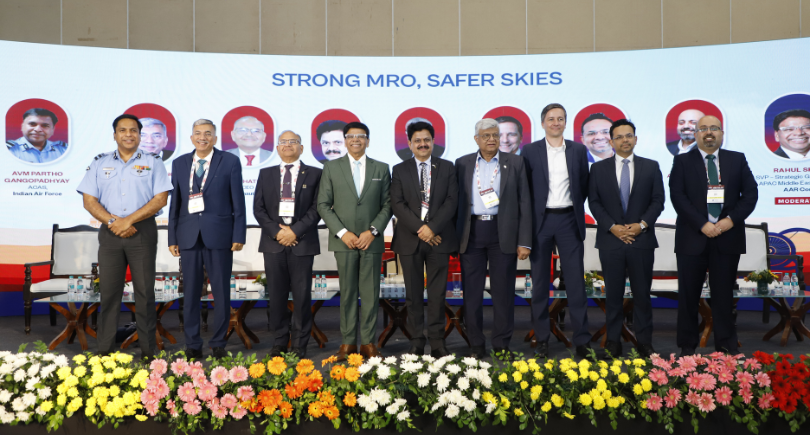
This central theme shaped Business Session 1 at the 7th Aerospace and Defence MRO South Asia Summit 2026, “Strong MRO, Safer Skies”. The session was moderated by Rahul Shah, SVP, Strategic Growth & Business Development APAC, Middle East & Africa at AAR Corp, the session brought together a diverse panel including AVM Partho Gangopadhyay, Indian Air Force, Prof. (Dr) Manoj Choudary, Saket Chaturvedi, S.K. Dash, Sharad Agarwal, Lars Moeslein, and Anubhav Kumar.
Setting the tone, Rahul Shah framed India’s position at a defining moment in its aviation journey. “India today stands at a defining inflexion point. It is one of the fastest-growing aviation markets globally. But fleet growth does not define maturity; what defines maturity is whether India can maintain, repair, overhaul, and support these assets at global standards, with safety and at scale.” He emphasised that the industry must now move beyond basic airframe maintenance and focus on higher-value, safety-critical domains.
“Engine and component MRO represents the highest technical competency, the highest capital intensity, and arguably the highest safety criticality. Every life-limited part and every repair decision have direct safety implications.”
Also Read-
A key debate during the session centred on whether India’s recent reliability concerns are isolated or indicative of deeper systemic issues. Lars Moeslein, Senior Vice President Corporate Sales at HAECO, brought the focus back to fundamentals: “Quality is all about people. If you build a mindset where teams think about safety and quality every day, that becomes the foundation. Everything else—regulation, technology, documentation supports that foundation.”
S.K. Dash, Group Chief Strategy Officer, Engineering at Air India, reinforced the complexity of the issue: “Reliability is not one problem; it is multiple factors coming together. It depends on components, maintenance quality, human factors, and the broader ecosystem.”
He highlighted operational pressures that continue to impact outcomes: “There is always pressure to release aircraft on time. If upgraded parts are not available or the supply chain does not support replacements, operations continue with limitations. Unless quality, parts availability, and maintenance time align, disruptions will persist.”
The consensus was clear. India’s reliability challenge is not isolated; it is systemic, driven by the intersection of people, processes, parts, and operational pressures.
As the discussion moved toward digital transformation, the role of AI and predictive analytics came under scrutiny. Anubhav Kumar, Head of Strategy & Policy at Boeing India and Southeast Asia, outlined the growing role of data: “AI and analytics are becoming integral to how the industry will evolve. From demand planning to predictive maintenance, structured and unstructured data can significantly improve aircraft health management and reduce downtime.”
However, the panel also struck a note of caution. AVM Gangopadhyay offered a grounded defence perspective: “AI is the buzzword today, but the sector remains largely reactive and will likely continue to be so for the next five to six years. The real challenge is predicting failures, and we are still at a nascent stage.”
He added: “What we need are practical, grounded solutions, not promissory ones. The journey has begun, but the results are still modest.”
The discussion highlighted a critical gap AI is only as effective as the quality and consistency of underlying data, an area where India still has work to do.
Perhaps the most critical takeaway from the session was India’s limited capability in high-value MRO segments. AVM Gangopadhyay pointed out:
“India’s MRO depth is still very shallow. Only about 15 per cent is handled domestically, while 85 per cent goes abroad, largely due to the lack of capability in engine and component MRO.” He stressed the need for stronger OEM collaboration: “The key lies in partnerships with OEMs. India has reached a scale where building in-country capability is now viable.”
Moeslein echoed the sentiment from a global MRO perspective. “The volume is there, and the appetite to invest is there. What’s missing is OEM support, lessor alignment, supply chain infrastructure, and the removal of market-entry barriers.”
Anubhav Kumar added an important nuance: “In many cases, repair intellectual property does not sit with the airframer but with tier-one suppliers. The real opportunity lies in matchmaking, bringing together global MRO expertise with strong Indian partners.”
The message was unequivocal: India cannot become a global MRO hub by focusing only on airframe maintenance, it must build depth in engines and components.
Another concern raised was the fragmented approach to MRO development across Indian states. Shah noted that multiple states are pursuing independent MRO ambitions, potentially diluting scale. Moeslein pointed to global benchmarks: “Successful MRO hubs like Singapore and Dubai work because they combine infrastructure, policy support, skilled labour, and a strong base load of customers. Without scale and concentration, it becomes difficult to build a sustainable business case.”
Dash added: “Airframe checks account for only about 15–16 percent of the MRO ecosystem. Unless India moves beyond basic shops into high-value segments, sustainable scale will remain a challenge.”
The panel agreed that India must think in terms of clusters and hubs, not isolated facilities.
Another important theme dominated the session, urgent need for skilled manpower.
Prof. Choudary raised a fundamental question: “Is MRO an aspirational career in India? If not, what needs to change? This cannot be solved through incremental efforts it requires a whole-of-sector approach.” He highlighted the need for standardised, industry-aligned education: “We need a large, uniform curriculum that produces industry-ready graduates from day one.”
Chaturvedi pointed to hiring challenges: “Finding certified AMEs remains a major challenge. The profession is still not positioned at par with graduate engineering roles, which affects its attractiveness.” Dash outlined Air India’s approach. “Unless students see a clear pathway to employment, they will not enter this field. That is why we launched an AME cadet programme with assured career progression.”
In the session’s closing round, panellists identified the two biggest risks to safer skies in India: talent shortages and supply chain gaps, telling reflection of the challenges ahead.
Agarwal summed up the industry’s commitment: “Our goal is to deliver high-quality, safe, and timely maintenance solutions while ensuring continuous airworthiness. A one-stop, responsive MRO ecosystem is critical to serving both domestic and global operators.”
The “Strong MRO, Safer Skies” session delivered a clear and urgent message that aviation safety cannot be separated from maintenance capability.
If India is to transition from a high-growth aviation market to a trusted global MRO hub, it must act decisively on four fronts, building engine and component capability, leveraging data and AI effectively, strengthening supply chains, and developing a skilled workforce at scale.
The takeaway was simple, yet powerful, Stronger MRO is not just an industry objective, it is the foundation of safer skies.