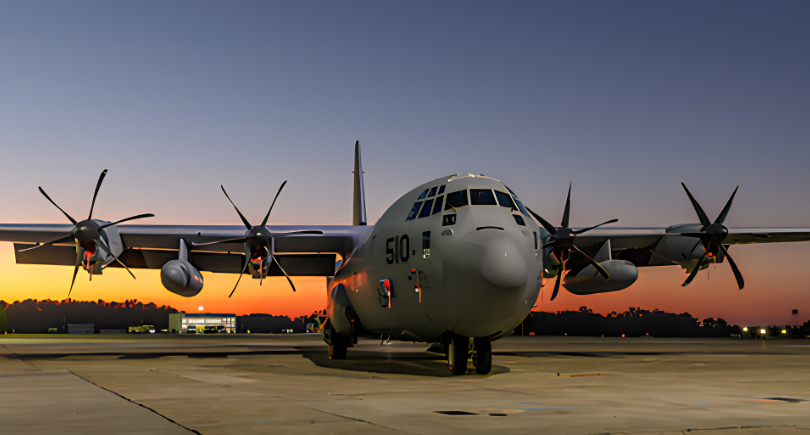

Lockheed Martin has delivered a C-130J-30 Super Hercules to the US Navy for conversion into the E-130J Phoenix II, initiating the mission-systems integration phase of a programme that will introduce new requirements for military aircraft modification, testing and long-term sustainment.
The aircraft was delivered at Lockheed Martin’s facility in Marietta, Georgia, on 15 October 2026. It will be transferred to Northrop Grumman, which will lead the integration of the specialised systems required for the Navy’s Take Charge and Move Out (TACAMO) mission, providing airborne support for strategic nuclear command and control.
The conversion will transform the standard C-130J-30 airframe into the E-130J Phoenix II, combining the Super Hercules platform with mission-specific communications equipment and survivability enhancements. The programme adds a specialised role to the C-130J family and brings the aircraft into a mission environment requiring close coordination between airframe modification, systems integration and verification.
For the MRO sector, the programme highlights the technical work involved in converting an established military transport platform for a highly specialised operational role. The integration process will require the installation and validation of mission systems alongside the aircraft’s existing avionics, electrical and structural configurations.
Trish Pagan, vice president of Lockheed Martin’s Air Mobility & Maritime Missions, described the delivery as a milestone for the Navy’s strategic communications capability, noting the C-130J-30’s established reliability and adaptability to new mission requirements.
Mission integration establishes future sustainment requirements
The C-130J-30 was selected for its endurance, range, payload capacity, fuel efficiency and advanced avionics. These characteristics provide the aircraft’s operational foundation, while the E-130J conversion will add the specialised equipment required for TACAMO operations.
US Navy Capt. Roger Davis, Airborne Strategic Command, Control and Communications program manager (PMA-271), said the delivered aircraft provides the structural and performance foundation for the mission as the programme moves into systems integration.
The aircraft’s modification will introduce additional technical considerations for future maintenance and support. Alongside routine airframe and propulsion maintenance, sustainment will need to account for the installed mission equipment, communications systems, associated electrical interfaces and configuration-specific technical documentation. Testing and integration activities will also be important to establishing the aircraft’s operational configuration before entry into service.
The programme revives the Hercules family’s historical connection with the TACAMO mission. The Navy previously operated the EC-130Q in this role from 1963 to 1993. The E-130J Phoenix II will build on that legacy using the newer C-130J-30 platform and updated mission systems.
Also Read – GA-ASI opens Dayton facility for UAS development and testing
The delivery does not itself mark the aircraft’s entry into operational service; it begins the next phase of its conversion. As Northrop Grumman and the wider industry team complete the integration work, the programme will progress towards fielding the specialised aircraft and establishing the technical support arrangements required throughout its service life.
For military MRO providers, the E-130J programme illustrates how a proven airframe can be adapted to a demanding mission through specialised modification and systems integration. Long-term availability will depend on maintaining both the underlying aircraft and its mission-specific equipment, supported by qualified personnel, technical data and configuration control.