


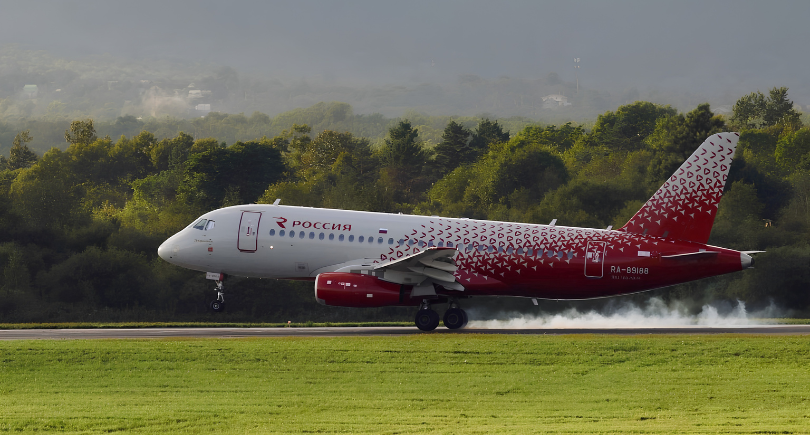

Russia’s Federal Air Transport Agency, Rosaviatsiya, has approved an increase in the designated service life of the Sukhoi Superjet 100 (SSJ-100) powered by SaM146 engines, raising its limits to 20 years, 40,000 flight hours, and 20,000 flights.
The Main Change Approval (MCA) covers the RRJ-95B-100 and extended-range RRJ-95B-LR-100 variants. The revised limits increase the previous thresholds of 15 years, 25,000 flight hours and 15,000 flights, allowing operators to plan for a longer aircraft service life, subject to applicable maintenance and airworthiness requirements.
Vladimir Lavrov, Chief Designer of the SSJ programme, said the new limits reflect confidence in the aircraft’s design and support continued operations by airlines. Yakovlev will continue work towards the design service-life targets for the SSJ-100 family.
The extension follows a process that evaluates the aircraft’s structural integrity and continued compliance with airworthiness requirements. Yakovlev determines extensions for major structural components using engineering calculations, full-scale testing and operational experience.
Assessments consider structural strength, fatigue life and corrosion to establish whether components can remain in service within approved limits. Service life is extended progressively as evidence supports operation towards the aircraft’s design limits.
Also Read – EPCOR signs five-year APU support agreement with mas for A330 fleet
Russia currently has 154 SSJ-100 aircraft in operation. The revised approval provides a longer designated service-life framework for the covered variants, with implications for maintenance planning, structural inspections and lifecycle management.
For MRO providers and operators, the extension places continued emphasis on condition assessment, corrosion control, structural inspections and maintenance records. The ability to substantiate continued airworthiness will remain central as aircraft accumulate additional flight hours and cycles.


