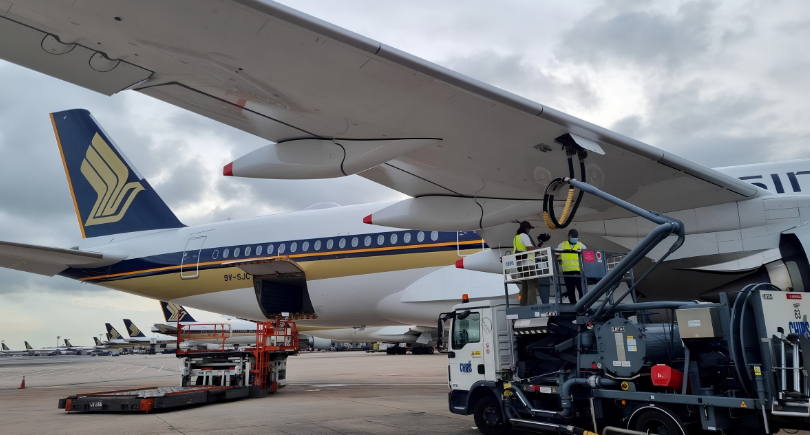

Singapore will introduce a Sustainable Aviation Fuel (SAF) Levy for origin-destination passengers and general and business aviation flights departing the country from 1 January 2027. The levy will apply to tickets and services sold from 1 October 2026 and must be shown as a separate line item in fare breakdowns.
The Civil Aviation Authority of Singapore (CAAS) said all SAF Levy proceeds will be channelled into a statutory SAF Fund to purchase SAF and related environmental attributes (EAs), as well as cover associated administrative costs.
Singapore Sustainable Aviation Fuel Company Ltd. (SAFCo), a non-profit company wholly owned by CAAS, will collect the levy and manage SAF procurement, environmental attributes and allocation. SAFCo will combine demand generated by the levy with voluntary SAF demand before procuring SAF and associated EAs.
The environmental attributes will be managed separately from the physical fuel and allocated through a traceable and verifiable process. SAFCo will manage Scope 1 and Scope 3 EAs, with Scope 1 attributes allocated to aircraft operators to support requirements under the International Civil Aviation Organization’s Carbon Offsetting and Reduction Scheme for International Aviation (CORSIA) and its long-term net-zero emissions goal.
Scope 1 allocations will be based on operators’ relative SAF Levy contributions, subject to a minimum allocation threshold of 0.01 per cent of total levy collections. CAAS expects this to cover more than 80 passenger aircraft operators.
SAFCo will centrally manage Scope 3 EAs and unallocated Scope 1 EAs. These will be made available to organisations seeking to address emissions associated with business travel and air freight. Proceeds from their sale will be used to purchase additional SAF.
SAFCo completed its first voluntary SAF procurement trial in August 2026 with support from CAAS. Nine organisations participated, including Singapore Airlines and Scoot, along with companies such as Changi Airport Group, DBS Bank, Google, OCBC and Temasek.
The trial was designed to test SAF procurement, commercial processes, accounting and environmental-attribute allocation. SAFCo plans to issue a request for proposal for SAF procurement funded through the SAF Levy by the end of 2026, with the first batch of SAF expected to be delivered and uplifted in mid-2027.
CAAS will delay the SAF Levy for air cargo shipments by one year. It will apply to services sold from 1 October 2027 for flights departing Singapore from 1 January 2028.
The authority said cargo operations involve a wider range of stakeholders, including airlines, express operators, freight forwarders and shippers, as well as more varied commercial arrangements. The additional year will allow CAAS and industry participants to establish the collection mechanism.
Mr Han Kok Juan, Director-General of CAAS, said, “CAAS has worked closely with airlines and other global industry partners to set up a robust regime for SAF levy collection, procurement and environmental attributes management. In doing so, CAAS seeks to lay the foundation for Singapore to serve as a trusted hub for SAF-related economic activities in the region.”
The SAF initiative does not directly fund MRO activities, but it forms part of the wider aviation decarbonisation effort affecting airlines, aircraft operators and their maintenance providers.
Also Read – Sustainable aviation fuel’s next chapter: From alternative feedstocks to global aviation strategy
The transition towards lower-carbon aviation adds to existing sustainability considerations covering energy consumption, materials, waste, emissions and aircraft lifecycle efficiency. Greater SAF adoption also brings increased attention to environmental reporting, emissions accounting and traceability across aviation supply chains.
Singapore’s phased implementation therefore provides another example of how sustainability requirements are becoming integrated across the aviation lifecycle, with implications for operators and the wider MRO ecosystem.