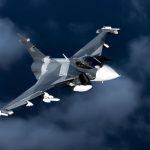
Saab has demonstrated its in-house artificial intelligence (AI) capabilities in flight trials involving the Gripen E fighter aircraft, validating the use of AI agents for autonomous decision-making in beyond-visual-range (BVR) air combat scenarios. The development marks progress in integrating AI technologies into operational fighter platforms and advancing future crewed and uncrewed combat aircraft capabilities.
The Swedish aerospace and defence company developed a family of AI agents through its Advanced Programs business unit. The agents are designed to support tactical decision-making in complex operational environments, working alongside pilots or operating autonomously on future unmanned air platforms.
Saab has developed the AI agents, training environments and supporting development tools internally, giving the company control over the technology’s development, verification and future upgrades.
During the flight trials, an AI agent autonomously controlled the Gripen E in BVR combat scenarios. The aircraft’s software-defined architecture enabled Saab to integrate and test new AI software directly on an operational fighter platform without requiring a dedicated experimental aircraft.
Peter Nilsson, head of Advanced Programs at Saab’s Aeronautics business area, said the successful flights demonstrated the company’s ability to develop AI agents and integrate them into operational fighter aircraft. He highlighted the importance of combining crewed and uncrewed platforms into coordinated combat systems.
AI Fighter Pilot Academy supports development and testing
A key element of Saab’s programme is its AI Fighter Pilot Academy, an initiative designed to develop, train and evaluate AI agents across different combat scenarios and platforms.
The agents undergo extensive training in simulated environments, accumulating millions of simulated flight hours across various operational conditions. Through repeated evaluation of their decisions against defined objectives, they learn to adapt tactics and improve their performance.
BVR air combat is one of the capabilities validated during the programme’s real-flight testing. The supporting infrastructure has also been designed to accommodate additional capabilities, scenarios and platforms without requiring the development framework to be rebuilt.
Saab is further supported by Sferical AI, a Swedish sovereign AI initiative providing large-scale computing capacity for advanced AI development. Saab is a founding partner in the initiative.
Software-defined architecture enables faster technology integration
The Gripen E’s software-defined architecture plays an important role in Saab’s AI development strategy. Its ability to accommodate new software technologies enables faster integration, testing and evaluation of advanced capabilities within an operational aircraft environment.
This approach can shorten development cycles and support more rapid transition from simulation-based research to flight validation.
Saab has also incorporated safety, verification and operational control into the AI development process, recognising the importance of maintaining trust and predictable behaviour when deploying autonomous technologies in military aviation.
Also Read – Royal Brunei Airlines selects Collins Aerospace services for Boeing 787 fleet
The company is continuing to expand its AI agents’ capabilities and conduct flight trials across a wider range of scenarios. Its longer-term objective is to support future combat environments in which crewed fighters and autonomous unmanned aircraft operate together as coordinated teams.
The development highlights the growing role of AI, software-defined systems and autonomous technologies in next-generation fighter programmes, while demonstrating how advanced aircraft architectures can support the integration and testing of emerging capabilities.