


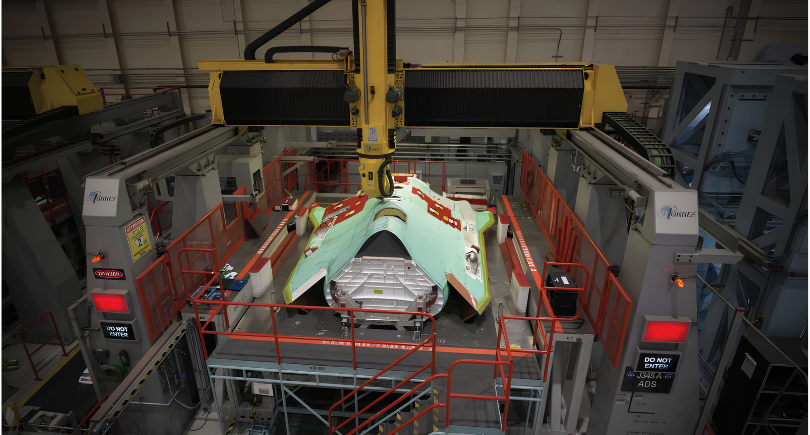

Northrop Grumman is expanding the use of automation, collaborative robotics, and artificial intelligence (AI) in F-35 component production to increase manufacturing throughput and improve quality control.
The company has introduced a collaborative robot, or co-bot, on its Communications, Navigation and Identification (CNI) production line. The system works alongside technicians to automate the installation of bolts used to attach the front housing of the CNI module.
According to Northrop Grumman manufacturing manager Lavell Catlin, the automated process has reduced a task that previously required several hours to a few minutes, while allowing technicians to be reassigned to other production activities.
“We recently installed a co-bot that assists technicians to precisely install bolts to attach the front housing area of the Communications, Navigation and Identification (CNI) module,” said Lavell Catlin, manufacturing manager for the CNI production line. “This system cuts what used to take hours to complete down to only a few minutes. Additionally, we’ve been able to shift a couple of our employees onto different key efforts, which improve the speed and performance of our overall production process.”
AI-based inspection supports production quality
Northrop Grumman is also applying AI-based quality-control tools to completed CNI modules. The systems analyse finished assemblies to identify potential defects or inconsistencies before units leave the production line.
The approach adds automated inspection to existing manufacturing quality processes and is intended to improve the consistency of completed avionics modules while reducing the risk of issues progressing into later stages of aircraft assembly.
“Our AI-based integration of quality control systems has greatly helped identify even the smallest issue in completed modules to ensure we’re delivering top-quality products every time,” Catlin said.
The use of AI and automation is being expanded across other areas of the CNI production line as Northrop Grumman works to improve repeatability and reduce production bottlenecks.
Automation increases F-35 production capacity
The CNI improvements form part of a broader automation strategy across Northrop Grumman’s F-35 manufacturing activities. At its Integrated Assembly Line in Palmdale, California, the company uses automation, robotics and mixed-reality tools to manufacture the F-35 center fuselage.
Northrop Grumman says the center fuselage, the aircraft’s largest stealth-critical structural assembly, is being produced at a rate of one unit every 30 hours. The company also manufactures composite structures including wing skins and nacelles for all three F-35 variants.
Automated composite manufacturing and production tooling are being used to support higher manufacturing rates while maintaining dimensional accuracy and repeatable quality across structural components.
Northrop Grumman is a major supplier on the Lockheed Martin-led F-35 programme, providing the center fuselage, avionics and communications systems, radar and other components across the F-35A, F-35B and F-35C variants.

Manufacturing improvements support long-term sustainment
Higher production efficiency has implications beyond new aircraft deliveries. As the global F-35 fleet expands, manufacturing capacity for avionics, structures, and replacement components will become increasingly important to long-term fleet sustainment.
Automated production and AI-assisted inspection can help establish more repeatable manufacturing processes while providing additional capacity for component production and potential replacement requirements.
Also Read – Northrop Grumman advances E-2D Block II upgrade for new and existing aircraft
Northrop Grumman’s production improvements therefore form part of the broader industrial infrastructure supporting the F-35 lifecycle. Increasing manufacturing throughput while maintaining quality is relevant both to aircraft production and to the ability of the wider F-35 supply chain to support an expanding fleet over its service life.
The continued integration of robotics, AI-based inspection and digital manufacturing tools is expected to remain an important element of Northrop Grumman’s approach to scaling F-35 production and supporting the programme’s long-term sustainment requirements.


