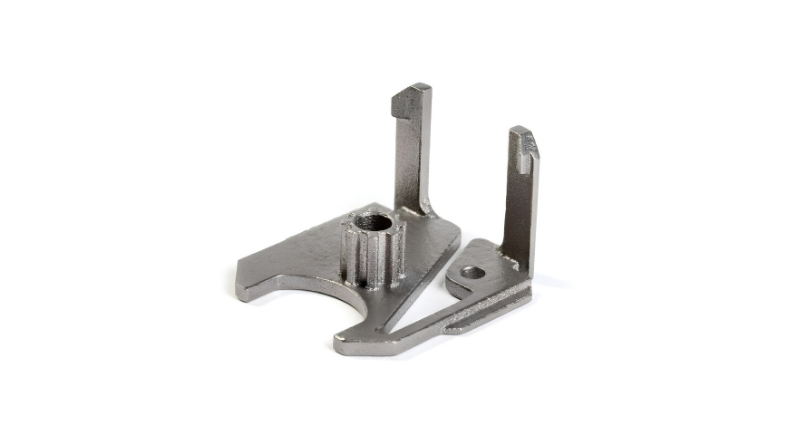

Lufthansa Technik has developed a new additively manufactured titanium latch for the window shade systems installed on Airbus A330, A340 and A380 aircraft, replacing a failure-prone plastic component with a more durable metal alternative.
The redesigned latch has now been certified and entered service, providing a new solution for an ageing component that had repeatedly experienced wear and damage during operation.
The project also demonstrates how additive manufacturing can help MRO providers address the challenge of maintaining difficult-to-source spare parts, particularly when individual replacement components are no longer available from the original manufacturer.
Replacing a failure-prone plastic component
The original component was an injection-moulded polymer latch used to secure the roller brake and end cap inside the aircraft’s window shade system. Although relatively small, the latch plays an important role in the operation of the window shade mechanism. During service, the component repeatedly showed signs of wear and damage.
A further challenge was that the original manufacturers did not offer the latch as an individual replacement part.
This meant that a failure could potentially require replacement of the complete window shade assembly, increasing both maintenance cost and the amount of material involved in the repair. Lufthansa Technik therefore decided to redesign the latch as an individual replacement component using metal additive manufacturing.
Titanium Selected for the Redesigned Latch
For the new component, Lufthansa Technik selected Ti6Al4V, a titanium alloy widely used in aerospace applications because of its strength and performance characteristics. However, simply reproducing the geometry of the original plastic component in titanium was not sufficient.
Because the material properties of titanium differ significantly from those of the original polymer, the component had to be redesigned to achieve the required mechanical behaviour. The engineering team adjusted factors including elasticity, wall thickness and geometry so that the titanium component could perform the same function as the original latch.
The objective was to create a stronger replacement while ensuring that the new part remained compatible with the existing window shade system.
Additive Manufacturing for spare-part availability
The redesigned latch is manufactured by Materialise in accordance with EN 9100 requirements. Before production began, Lufthansa Technik and Materialise worked together to establish the necessary manufacturing controls, process stability requirements and quality standards. Materialise also completed the required supplier qualification process.
Lufthansa Technik holds EASA Part 21.G and Part 21.J approvals covering the manufacture and development of flight-worthy components, supporting the development and certification process for the redesigned part.
Following the required qualification and certification activities, the new titanium latch was approved for service and has entered operation.
Longer service life, easier repairs
The use of titanium is expected to provide a longer service life compared with the original plastic latch because of its higher strength. However, one of the key benefits of the project is not simply the stronger material.
The redesigned component is now available as an individual replacement part. If the latch is damaged in the future, maintenance teams can replace the individual component rather than having to replace the complete window shade system.
This can help reduce maintenance costs, minimise unnecessary component replacement and improve the availability of spare parts for aircraft that continue to operate with ageing or difficult-to-source equipment.
A practical MRO application for 3D printing
The project highlights an increasingly important application of additive manufacturing in aviation MRO. While 3D printing is often associated with developing new aircraft components and lightweight structures, the technology can also provide a practical solution for legacy components, low-volume parts and difficult-to-source spares.
For MRO organisations, the ability to redesign and manufacture an individual replacement component can be particularly valuable when an original part is no longer commercially available or when replacing an entire assembly is unnecessarily expensive.
The Lufthansa Technik project demonstrates how additive manufacturing can combine engineering redesign, material improvement and digital production to address a specific maintenance challenge. In this case, a small window shade latch became an opportunity to rethink how an individual spare part is designed, manufactured and supplied.
Also Read – Vietjet Qazaqstan goes live with AMOS Airline Edition, modernising maintenance operations
For operators of older aircraft such as the A330, A340 and A380, such solutions could become increasingly relevant as fleets age and maintaining reliable access to individual replacement components becomes more challenging.
The project ultimately shows that additive manufacturing does not always need to involve a major aircraft structure to deliver value. Sometimes, a small component can make a significant difference to the economics and efficiency of aircraft maintenance.