
Lufthansa Group and Munich Airport (FMG) have extended their long-standing joint venture agreement through to 2056, reinforcing Munich’s role as a key European aviation hub and laying the groundwork for sustained long-term capacity expansion.
At the centre of the renewed partnership is the planned expansion of Terminal 2, anchored by the construction of a new pier the “T-Pier” which will be integrated with the existing satellite terminal infrastructure. The project marks a major step in scaling Munich’s hub capabilities in line with rising passenger demand and evolving airline network strategies.
Scheduled for completion in 2035, the new T-Pier is expected to increase Terminal 2’s annual capacity by up to 10 million passengers. This expansion will enable Lufthansa to further develop Munich as a long-haul gateway, strengthening connectivity across intercontinental markets while easing congestion at existing facilities.
From a network planning perspective, the additional capacity will provide greater flexibility in slot management, aircraft deployment, and route expansion particularly as airlines recalibrate operations in response to shifting global demand patterns.
Also Read: Dassault Aviation posts strong 2025 results as it eyes higher sales and deliveries in 2026
The extended joint venture underscores the continued success of the Lufthansa–FMG partnership, which has been instrumental in positioning Munich as one of Europe’s most efficient and passenger-centric hubs.
Beyond physical infrastructure, the expansion is expected to deliver broader economic and industrial benefits, including creation of high-skill employment across airport and support services, strengthening of regional aerospace and aviation ecosystems and enhanced competitiveness of Germany as a global aviation gateway
As hub airports scale, the integration between airline operations, maintenance planning, and airport infrastructure becomes increasingly critical particularly in ensuring turnaround efficiency and fleet reliability.
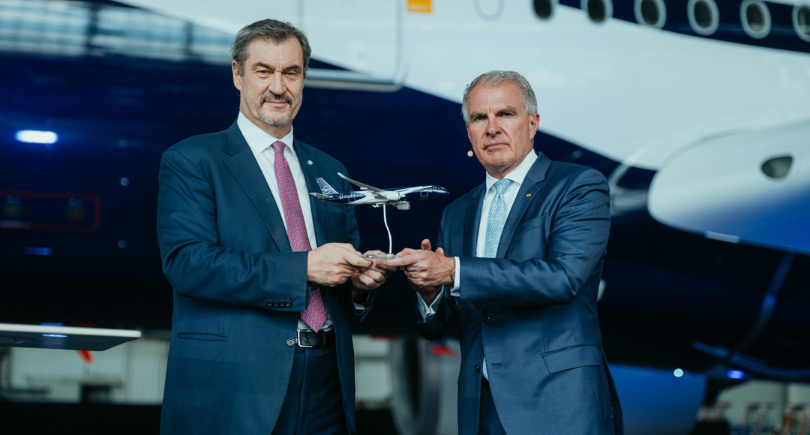
Commenting on the development, Lufthansa CEO Carsten Spohr emphasised that the investment reflects a long-term commitment to building resilient, high-performance aviation infrastructure.
He highlighted that in an increasingly complex geopolitical environment; strong and well-connected hubs are essential for maintaining independent global connectivity. Munich’s expansion, alongside continued investment in Lufthansa’s Frankfurt hub, forms part of a broader strategy to reinforce Germany’s position in global aviation networks.
The extension of the Lufthansa–Munich Airport joint venture to 2056 signals a clear long-term commitment to capacity growth, infrastructure modernisation, and network expansion.
Munich’s next phase of growth, therefore, is not just about passenger capacity, but about building a fully integrated aviation ecosystem capable of sustaining long-term, high-volume operations.