


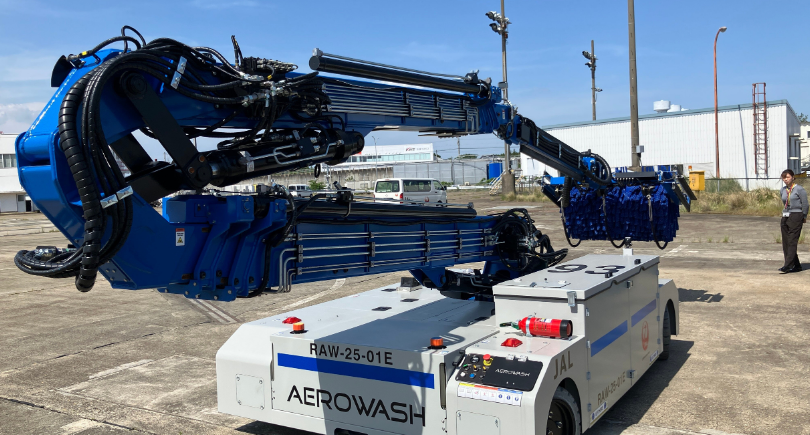

Japan Airlines (JAL) Group is advancing its airport digital transformation strategy with the introduction of the Aerowash Remote-Controlled Aircraft Washing Robot (AW3) at Narita Airport, marking the first deployment of a collaborative aircraft washing robot of its kind by a domestic airline in Japan.
Following a comprehensive operational training programme, JAL plans to begin full-scale implementation of the system in 2026. The initiative is aimed at improving the efficiency, safety and sustainability of aircraft exterior washing operations while reducing the physical burden on ground handling personnel.
Aircraft exterior washing is an important part of ground operations, helping maintain aircraft cleanliness and supporting aerodynamic performance. Traditionally, the task has relied heavily on manual labour, with ground staff working overnight and using long-handled mops and specialised cleaning agents to wash aircraft surfaces.
JAL’s latest deployment represents a renewed effort to automate the process. The airline previously explored the use of a wired remote-controlled aircraft washing system approximately three decades ago, but technical limitations prevented the technology from being adopted for sustained operations.
The AW3 introduces more advanced control capabilities and is designed around a human-machine collaborative operating model. According to JAL, the deployment represents its first major initiative in three decades to pursue program-controlled aircraft washing.
Combining automation with human control
A key feature of the AW3 is its ability to use pre-programmed coordinates corresponding to different areas of an aircraft. The robotic arm can autonomously approach designated sections, including the main wings and tail, based on programmed positions.
Rather than completely removing human involvement, the system combines automated movement with operator intervention. As the robotic arm approaches the aircraft surface, operators use handheld controls to make fine adjustments and guide the equipment during the washing process.
JAL says this collaborative approach is intended to balance automation and operational precision while maintaining the safety standards required for aircraft ground operations.
The AW3 is also equipped with an omnidirectional four-wheel steering (4WS) drive system, allowing the unit to manoeuvre more flexibly around the aircraft and achieve accurate positioning during washing operations.
The system’s aircraft-specific programmed approach and multi-axis control capabilities are among the features that JAL identifies as a first for a domestic airline in Japan, based on the airline’s research.
Reducing labour intensity and improving workplace safety
The introduction of the washing robot is also closely linked to JAL’s efforts to address the physical demands associated with aircraft exterior maintenance activities.
Aircraft washing can involve prolonged periods of manual work, including working at height and handling equipment and cleaning materials. By introducing robotic assistance, JAL aims to reduce the physical strain placed on employees and improve overall working conditions.
The technology is expected to reduce the amount of manual work involved in washing aircraft while allowing personnel to focus on operating and supervising the system.
According to performance figures provided by AW3 manufacturer Aerowash, the system has the potential to reduce aircraft washing time by up to 40% per aircraft compared with conventional manual washing methods.
JAL plans to validate these performance figures through actual operations at Narita Airport and use the results to identify further opportunities to improve productivity and ground handling efficiency.
The system is also designed to reduce employees’ direct exposure to cleaning agents, while limiting the need for physically demanding activities associated with working around and above aircraft surfaces.
Water conservation and lower on-ground emissions
Sustainability is another important element of JAL’s aircraft washing robot initiative. According to Aerowash catalogue figures, the AW3 has the potential to reduce water consumption by up to 50% per aircraft compared with conventional washing processes. JAL will assess the actual resource savings achieved during operational deployment.
The equipment is fully electric and battery powered, eliminating the need for conventional fuel-powered operation at the work site and helping reduce local CO2 emissions associated with the washing process.
The combination of lower water consumption, electric operation and reduced manual intervention gives the technology a role beyond simple automation, supporting JAL’s broader efforts to improve the environmental performance of its airport operations.
From trial to wider deployment
JAL’s initial deployment at Narita Airport will provide the airline with an opportunity to evaluate the AW3 under operational conditions and assess its impact on productivity, safety, employee wellbeing, resource consumption and aircraft washing quality.
Following the introduction at Narita, JAL intends to explore the potential deployment of the technology at other domestic airports.
The airline’s approach reflects a broader shift within aviation ground operations, where robotics, automation and digital technologies are increasingly being evaluated to address labour constraints while improving operational consistency and workplace safety.
For JAL, the AW3 is therefore positioned as part of a wider airport digital transformation programme rather than a standalone automation project.
By combining programmed robotic movements with human supervision and intervention, the airline aims to develop a model that retains the experience and judgement of ground personnel while reducing repetitive and physically demanding tasks.
As the aviation industry continues to face pressure to improve ground handling productivity and respond to workforce challenges, technologies such as aircraft washing robots could become increasingly relevant across airport and MRO environments.
JAL’s planned 2026 implementation at Narita will provide an important operational test of how far robotic assistance can improve aircraft exterior washing while maintaining the safety, quality and precision requirements of commercial aviation.
The airline said it will continue using advanced technologies to enhance the safety, quality and productivity of ground handling operations, while pursuing a workplace environment that supports employee wellbeing and more sustainable flight operations.


