


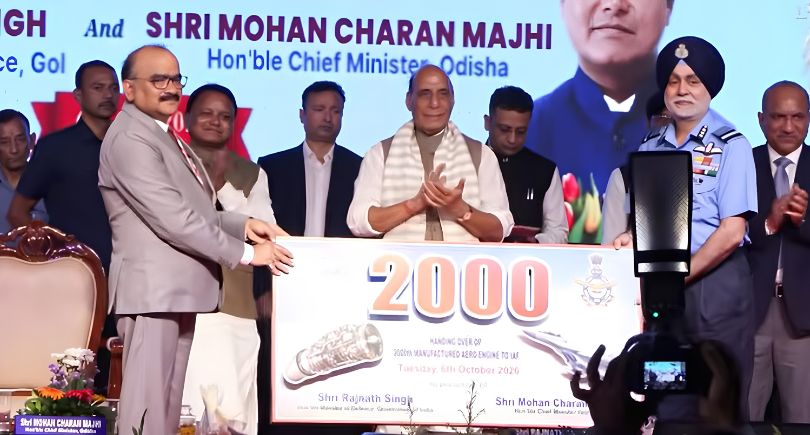

India’s Hindustan Aeronautics Limited’s (HAL) Koraput division in Odisha has reached a major milestone with the delivery of its 2,000th aero-engine, as India steps up efforts to build greater domestic capability in aircraft and helicopter propulsion.
At an event at the Koraput facility in Odisha, India’s Defence Minister Rajnath Singh announced a second production line for the Shakti helicopter engine, backed by an investment of Rs 218 crore. The new line is scheduled to be fully established by 2028-29 and will have the capacity to produce up to 100 engines annually for indigenous helicopter platforms, including the Dhruv Advanced Light Helicopter (ALH) and Prachand Light Combat Helicopter (LCH).
For India’s MRO and defence aviation ecosystem, however, the development is significant beyond the additional production capacity. The government is looking to transform Koraput from an engine manufacturing and overhaul facility into a broader aerospace propulsion ecosystem, with stronger participation from domestic suppliers, MSMEs, start-ups, research institutions and technology partners.
From engine production to lifecycle capability
Established in 1964, HAL Koraput has supported several generations of India’s military aircraft, including the MiG-21, MiG-27, MiG-29 and Su-30MKI. The division has manufactured 2,000 aero-engines and overhauled more than 9,000 engines, underlining the importance of the facility not only to new production but also to the maintenance and service-life extension of India’s defence fleet.
This manufacturing-plus-overhaul capability is particularly relevant as India seeks to improve the availability of critical defence platforms.
For an MRO ecosystem, engine production is only one part of the equation. Sustaining an engine through its operational life requires access to components, repair capability, technical expertise, testing infrastructure and a reliable supply chain.
Singh stressed this lifecycle perspective, noting that while production creates new capability, overhaul extends service life and both are critical to military preparedness.
Second Shakti line supports helicopter growth
The new Shakti production line comes as India’s indigenous helicopter fleet expands. The Shakti is a turboshaft engine developed through the collaboration between HAL and Safran Helicopter Engines and powers platforms including the Dhruv and Prachand.
The additional production capacity is expected to support the growing requirements of these helicopter programmes. The Ministry of Defence has also placed major orders for Prachand helicopters, creating a corresponding requirement for engines and long-term support capability.
The development illustrates an important shift in India’s defence manufacturing strategy: building aircraft and helicopters domestically increasingly needs to be accompanied by domestic capability to manufacture, maintain and support their propulsion systems.
For MRO providers and the wider aftermarket, that could create opportunities across engine maintenance, component repair, technical services, tooling, testing and supply-chain support.
AL-31FP capacity to rise to 50 engines annually
HAL is also expanding its production capability for the AL-31FP engines used by the Indian Air Force’s Su-30MKI fleet. Annual production capacity at Koraput will increase from 30 to 50 engines, supported by an investment of Rs 335 crore. The move comes under a 2024 order for 240 AL-31FP engines.
According to the Ministry of Defence, HAL has delivered 63 engines against a target of 60 by the end of the second year of the programme, despite global supply-chain disruptions and raw-material challenges.
The programme is particularly important from an availability perspective. With the Su-30MKI forming a major part of India’s combat aircraft fleet, dependable access to engines and associated maintenance capabilities is critical to sustaining operational readiness.
It also demonstrates why engine supply chains have become an increasingly important part of the defence MRO conversation.

Building the supply chain around Koraput
The next challenge is to develop a deeper industrial ecosystem around HAL’s core capabilities. Singh called on HAL to work with MSMEs, start-ups, universities and research institutions and develop suppliers capable of producing critical engine components.
Such an ecosystem could reduce dependence on imported components and raw materials while giving Indian companies greater opportunities to participate in the aerospace aftermarket.
For MRO, the implications are significant. A stronger domestic component ecosystem can potentially reduce lead times, improve parts availability and create additional repair and manufacturing capacity closer to the aircraft and engine operators.
This is also where the Make in India strategy intersects directly with MRO resilience.
Propulsion technology remains the bigger challenge
Despite the progress at Koraput, India still faces a much larger challenge in developing advanced indigenous propulsion technology.
Singh highlighted the need to strengthen domestic capabilities in superalloys, advanced materials, precision manufacturing, cooling technologies, testing and quality assurance.
These capabilities will be essential for India’s next-generation combat aircraft programmes, particularly the Advanced Medium Combat Aircraft (AMCA).
The government is pursuing an indigenous high-thrust engine programme involving a proposed investment of around Rs 5,000 crore, along with efforts to develop indigenous raw materials with MIDHANI and establish India’s first indigenous high-thrust engine testing facility. The significance for MRO extends well beyond the development phase.
Advanced propulsion capability eventually translates into domestic expertise in engine maintenance, overhaul, repair, component manufacturing, testing and lifecycle support.
A new role for Koraput
The 2,000th engine is therefore both a milestone and a starting point.
Koraput already brings nearly six decades of engine manufacturing experience together with a substantial overhaul capability. The expansion of Shakti production, the increase in AL-31FP capacity and the push for advanced propulsion technologies could now allow the facility to evolve into a much broader aerospace propulsion hub.
For India’s defence MRO sector, the opportunity is particularly important.
A mature propulsion ecosystem would connect new engine production with overhaul, repair, component manufacturing, testing, supply-chain development and lifecycle support.
Also Read – HAL and SkyPulse sign MoU for 30-helicopter acquisition and lifecycle support programme
That is ultimately the larger objective behind India’s push for greater self-reliance: not simply to manufacture an engine domestically, but to develop the industrial capability to support that engine throughout its operational life.
As India expands its indigenous aircraft and helicopter fleets, that distinction will become increasingly important to the country’s MRO and defence readiness strategy.


