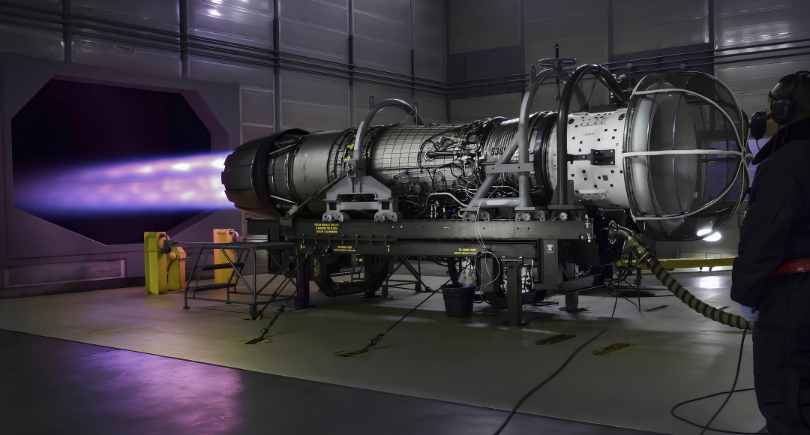

GE Aerospace has increased F110 engine production through manufacturing investment, supply-chain measures, and new digital tools as demand grows for the engine supporting F-15EX and F-16 fleets.
The F110 has accumulated more than 11 million flight hours across four decades of service. GE Aerospace has increased annual F110 output by 50% year over year since the second quarter of 2025, while total defense engine production rose 15% in the first half of 2026.
The production increase follows more than $600 million invested in GE Aerospace’s defense manufacturing facilities since 2023, alongside more than $100 million committed to external suppliers for tooling and equipment. The company is also using dual sourcing and targeted capacity investments for critical components to reduce supply-chain constraints.
F110 production receives manufacturing and supply-chain upgrades
GE Aerospace has modernized approximately 90% of F110 parts, introducing updated materials, coatings, manufacturing processes and inspection methods. The engine programme also uses additive manufacturing.
In 2021, the US Air Force qualified an additively manufactured F110 sump cover, making it the first metal 3D-printed engine component of its type to receive airworthiness approval from a US Department of Defense entity.
The company has also focused on identifying production constraints earlier through closer coordination with suppliers. Engineering and quality teams have been working with the external supply base to address bottlenecks, stabilize demand signals, and improve supplier readiness.
GE Aerospace’s planned acquisition of Consolidated Precision Products (CPP) is another element of its supply-chain strategy. CPP manufactures castings, a category of components that remains a capacity constraint across the aerospace industry.
Production improvements are also being made directly on the F110 manufacturing line. During a recent improvement programme, GE Aerospace reduced the production lead time of the high-pressure compressor forward shaft by approximately 60% by consolidating processes and reducing operator travel within the facility.
AI and digital tools support production and sustainment
GE Aerospace is applying artificial intelligence to both manufacturing and engine sustainment activities. Technicians working on the F404 and F110 production lines have used AI tools to identify supply-chain risks, gaps, and potential bottlenecks earlier in the manufacturing process.
The approach is intended to give production teams greater visibility of material availability and supplier dependencies before they affect engine deliveries.
The company is also expanding its use of AI-enabled predictive maintenance and working with Palantir on agentic AI applications for aircraft sustainment and manufacturing decision-making.
“Artificial intelligence is changing how we build and sustain the F110,” says Shawn Warren, vice president and general manager of combat and trainer engines in GE Aerospace’s Defense & Systems business. “It’s giving our teams the ability to see problems before they become delays, and to move faster without sacrificing the reliability our Air Force customers depend on.”
Also Read – HAL prepares first HTT-40 deliveries as engine supply bottleneck eases
The combination of manufacturing upgrades, supply-chain investment and digital tools is intended to increase F110 production capacity while supporting the engine’s long-term sustainment requirements.
With F110 demand increasing, GE Aerospace is therefore expanding not only engine output but also the industrial and technical infrastructure required to manufacture, maintain, and sustain the engine for US and allied operators.