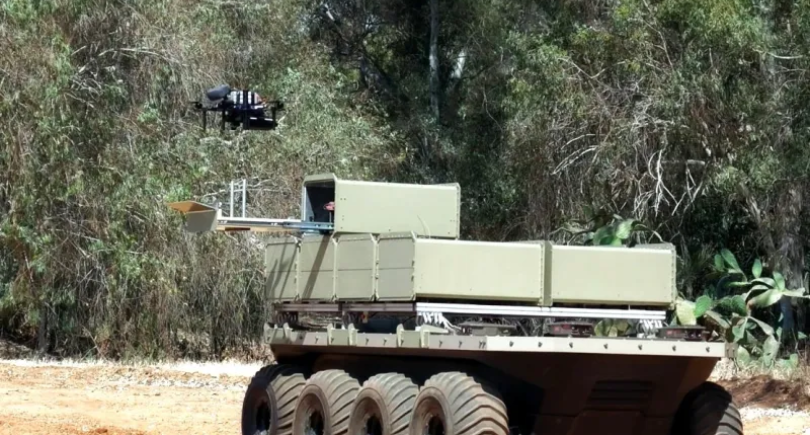

Elbit Systems’ newly unveiled FUSE portfolio is highlighting the growing importance of maintenance, fleet readiness and lifecycle support as defence forces expand their use of autonomous aerial and ground systems.
FUSE combines AI-driven autonomous platforms with One2Many operational capabilities, enabling centralised coordination of multiple unmanned systems across air and land domains. From an MRO perspective, the development points to the need for scalable maintenance and sustainment models capable of supporting increasingly large and diverse unmanned fleets.
At the centre of the portfolio is Dominion-X, an AI-powered operating system designed to coordinate autonomous systems and share mission data across platforms. The technology is intended to support operations in contested and GNSS-denied environments while integrating unmanned assets with existing military formations.
Autonomous fleets create new MRO requirements
As defence operators deploy autonomous systems at greater scale, maintenance organisations will need to manage larger fleets of drones, unmanned ground vehicles and autonomous systems alongside conventional military platforms.
FUSE’s portfolio includes unmanned tactical systems, swarm drones, unmanned ground vehicles, airborne and ground wingman systems, border defence platforms and multi-mission vertical take-off and landing systems.
The company said its autonomous technologies have accumulated more than 1 million operational flight hours and 100,000 autonomous ground-operation hours. Thousands of drones and hundreds of unmanned ground platforms have already been delivered to customers worldwide.
This operational scale creates potential demand for new approaches to inspection, diagnostics, component replacement, software maintenance and fleet-level lifecycle management.
Also Read – SkyDrive reaches 300 eVTOL test flights
Digital technologies reshape defence sustainment
FUSE’s emphasis on AI, autonomous operations and networked platforms also reflects the increasing role of digital technologies in defence MRO.
For maintenance organisations, connected autonomous fleets could enable greater visibility of asset condition and operational performance, supporting more proactive maintenance planning and helping operators maintain availability across distributed fleets.
The ability to integrate autonomous capabilities into existing tactical assets and combat vehicles could also allow defence forces to expand their unmanned capabilities without creating entirely separate operational structures. This could have implications for training, spare-parts management, maintenance infrastructure and technical support.
Scaling lifecycle support
FUSE’s systems are already deployed with customers in Israel, the United States and Europe, according to Elbit Systems. The company said its solutions are designed for scalable production, rapid field integration and sustained operational deployment.
For the defence MRO sector, the expansion of autonomous fleets is likely to shift attention from simply maintaining individual platforms towards managing the availability and lifecycle of large, interconnected fleets.
Eyal Dahan, CEO of FUSE, said the company is focused on combining autonomous platforms, operational AI and scalable One2Many capabilities into solutions that can be integrated into modern combat formations.
As autonomous systems become more widely adopted, their long-term effectiveness will increasingly depend not only on their operational capabilities but also on the industry’s ability to provide reliable maintenance, repair, upgrades and lifecycle support at scale.