
EKOLOT Aerospace & Defense (EAD) is expanding its unmanned aircraft portfolio with Counter-UAS (C-UAS) systems that combine intelligence, surveillance and reconnaissance (ISR) capabilities with detection, tracking and engagement functions.
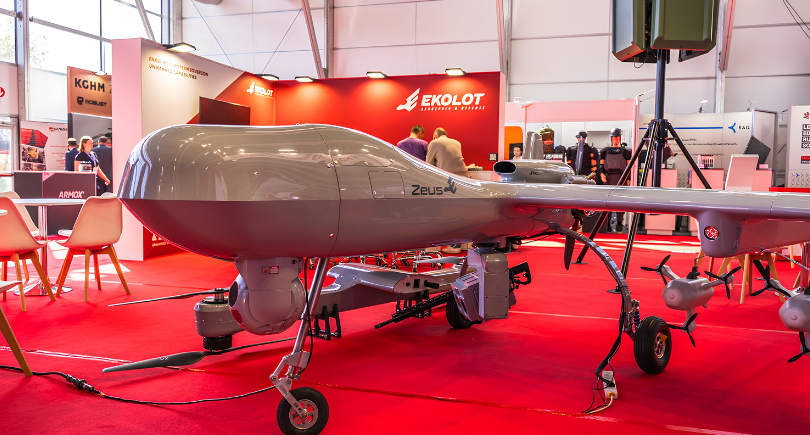
The Polish company is developing the systems around its ZEUS family of unmanned aircraft, using the platform’s modular architecture to integrate different sensors, payloads and mission systems for applications including force protection, critical infrastructure protection and Counter-UAS operations.
EAD is developing three operational concepts covering direct engagement, airborne deployment of interceptor systems, and the integration of lightweight guided effectors on Class II unmanned aircraft.
The Direct Engagement System combines a ZEUS unmanned platform with electro-optical/infrared (EO/IR) sensors and a remotely operated weapon system. The configuration is intended to provide an airborne capability for detecting, tracking, and engaging targets while operating close to protected assets.

The second concept, the Airborne Mothership & Interceptors System, uses a larger UAV to carry and manage multiple smaller interceptor platforms. The configuration is being developed to extend airborne sensing and interception capabilities over a wider area and support protection of high-value assets.
The third concept involves the integration of lightweight guided effectors onto Class II UAS. The configuration is intended to add an engagement capability to medium-sized tactical UAVs while retaining their ISR and other mission functions.
Also Read – Gremsy and Nokia advance 5G drone technologies for emergency response
The C-UAS development builds on the ZEUS platform family’s ability to accommodate different sensors, payloads, and mission equipment. This modular approach allows the aircraft configuration to be adapted for different operational requirements without changing the core platform.
EAD is positioning the systems for European defence and security applications, with a focus on interoperability, modular mission architectures and rapid deployment. The development also expands the company’s role from UAV platforms into integrated mission systems and Counter-UAS capabilities.