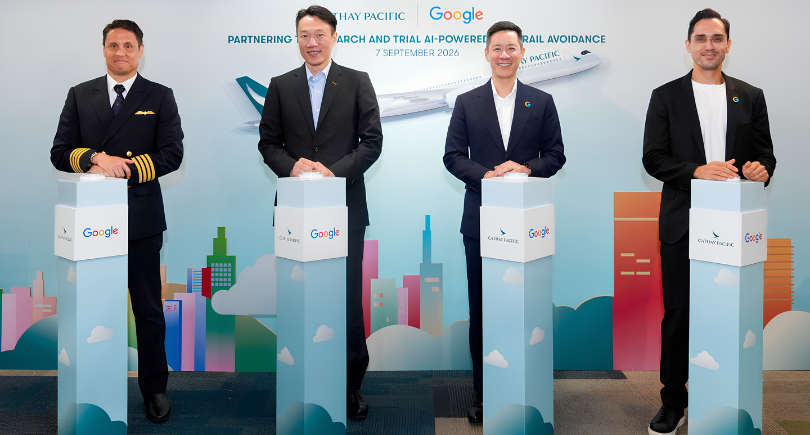

Cathay Pacific and Google are expanding trials of an artificial intelligence-powered system designed to help aircraft avoid atmospheric conditions that can create persistent contrails, following early tests that the companies say reduced the estimated warming impact of contrails by around 40%.
The initiative marks another step towards bringing predictive AI into live airline operations, with the technology combining AI-based forecasts, satellite imagery and weather intelligence to identify areas where persistent contrails are likely to form. Flight dispatchers and pilots can then consider small altitude adjustments to avoid those areas when operationally feasible.
The expanded programme will cover Cathay Pacific’s Asia-Pacific and transpacific network, including ultra-long-haul operations. Cathay is Google’s first commercial airline partner in Asia-Pacific to trial the technology and the first airline globally to test contrail avoidance on ultra-long-haul flights.
From AI prediction to flight operations
The technology addresses a relatively less visible aspect of aviation’s climate impact: persistent contrails. Contrails are formed when aircraft fly through very cold and humid atmospheric conditions at cruising altitude. Water vapour from engine exhaust can condense and freeze around particles in the exhaust, producing the familiar white trails behind aircraft.
While many contrails disappear quickly, some persist and spread into larger ice-cloud formations. These persistent contrails can trap heat in the atmosphere and contribute to aviation’s overall climate impact.
Google and Cathay Pacific estimate that persistent contrails could account for around one-third of aviation’s total climate impact, making contrail mitigation an increasingly important area of research alongside conventional carbon-reduction measures.
Early trials show 40% reduction in warming impact
Cathay Pacific and Google began operational trials in late 2025, targeting more than 100 flights across the airline’s network. More than 80 flights ultimately followed contrail-avoidance routes.
According to Google’s satellite-based analysis, those flights achieved an estimated 40% reduction in the warming impact of contrails compared with the expected impact without avoidance measures. One of the routes included in the trial was the Hong Kong-Singapore corridor, where atmospheric conditions can frequently support persistent contrail formation.
The companies stress that the results are based on individual operational trials and that further testing is required to determine how effectively contrail avoidance can be scaled across different routes, airspaces and operating conditions.
How AI works
Rather than requiring a new aircraft or propulsion system, the approach focuses on making existing flight operations more climate-aware. Google’s system uses predictive AI alongside satellite imagery and weather data to forecast areas where aircraft are more likely to create persistent contrails. This information can be provided to airline operations teams and flight crews ahead of and during a flight.
If a potential contrail-forming region is identified, the aircraft can potentially make a small altitude adjustment to avoid the area, subject to safety, airspace, aircraft performance, payload and other operational considerations.
The concept is similar to the altitude changes already made for operational reasons such as weather and turbulence—but with contrail formation added as another factor in the decision-making process.
Cathay has integrated the information into its Electronic Flight Folder (EFF), allowing pilots to access dynamic contrail forecasts alongside other operational information through the airline’s existing systems.
This integration is significant because it moves the technology beyond a theoretical AI model and into the actual airline operating environment.
Why is this important for airline
The potential attraction of contrail avoidance is that it does not depend on waiting for a completely new generation of aircraft or alternative propulsion technology. Existing aircraft and fuels can potentially be used.
For airlines, this creates an additional sustainability lever that can work alongside fleet renewal, sustainable aviation fuel, operational efficiency, and other decarbonisation initiatives. However, operational practicality remains critical.
A flight cannot simply change altitude every time an AI system identifies a potential contrail. Air traffic control restrictions, available flight levels, weather, turbulence, aircraft weight, fuel burn, payload and route constraints all have to be considered.
The second phase of the Cathay-Google programme will therefore be important in determining not just whether contrails can be avoided, but how consistently the technology can be incorporated into normal airline operations.
Ultra-Long-Haul flights
The expanded trials will place particular emphasis on ultra-long-haul flights across Cathay Pacific’s Asia and transpacific network. Long-haul operations provide a valuable testing environment because aircraft spend extended periods at high altitude and can encounter a wide range of atmospheric conditions during a single flight.
Cathay’s participation will also help generate more operational data from the Asia-Pacific region, which has been less represented in previous real-world contrail trials. The second phase will also involve Contrails.org, a nonprofit initiative focused on advancing contrail mitigation research.
A new role for AI in aviation sustainability
The programme highlights how the role of AI in aviation is expanding beyond areas such as predictive maintenance, passenger services, revenue management and flight optimisation.
AI is increasingly being explored as an operational decision-support tool capable of processing large amounts of data and translating it into actionable information for flight crews and airline operations teams. In this case, the system is effectively attempting to answer a very specific operational question:
Where can an aircraft fly to minimise the likelihood of creating a persistent, climate-warming contrail without compromising safety or operational efficiency?
Michael Yue, Managing Director and General Manager of Google Hong Kong, said the partnership is examining how predictive AI can be deployed in live operations to address contrail-related climate impact using existing aircraft and fuels.
Cathay Pacific Director of Digital and IT Lawrence Fong said aviation needs solutions to address climate change and that AI can accelerate progress in this area.
Beyond carbon emissions
The development also reflects a broader shift in aviation’s sustainability conversation. For years, the industry’s primary focus has been on reducing CO₂ emissions through more fuel-efficient aircraft, sustainable aviation fuel and improved operational efficiency. However, aviation’s climate impact also includes non-CO₂ effects, including those associated with persistent contrails.
Addressing these effects does not replace the industry’s need to reduce carbon emissions. Instead, contrail avoidance could become another tool within a broader sustainability strategy.
For airlines and their technology partners, the attraction is clear: if predictive AI can identify climate-sensitive atmospheric conditions in advance and allow aircraft to make relatively small operational adjustments, the potential solution can be introduced without waiting for the global fleet to be replaced.
From trial to industry-scale application
The immediate objective of the expanded Cathay-Google programme is therefore not to declare contrail avoidance a finished solution, but to build a much larger real-world dataset.
The trials will help researchers understand where contrail avoidance delivers the greatest benefit, how frequently altitude adjustments are operationally possible, and what constraints airlines face when incorporating the technology into everyday flight planning.
For the MRO and wider aviation ecosystem, the development is another indication of how data, AI and digital decision-making are becoming increasingly embedded in aircraft operations.
The technology does not require airlines to redesign their aircraft. Instead, it potentially changes how existing aircraft are operated.
If the expanded trials confirm the early results and demonstrate that contrail avoidance can be integrated safely and consistently into airline operations, AI-powered climate optimisation could become another important tool in aviation’s sustainability toolkit—alongside next-generation aircraft, sustainable aviation fuels, operational efficiency and advanced digital technologies.