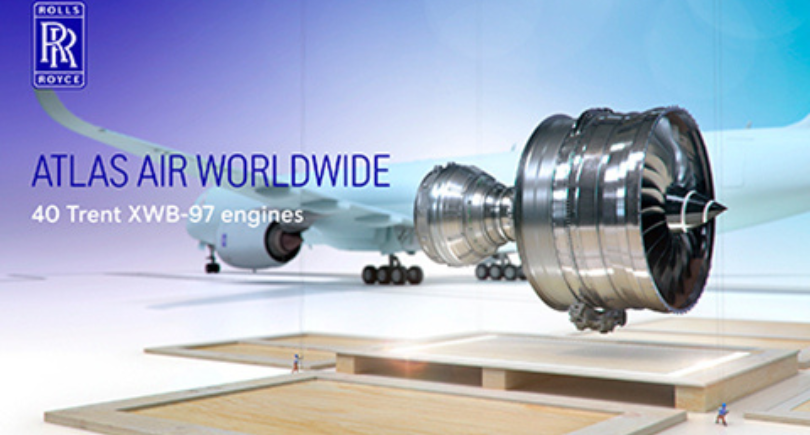

In a major widebody freighter development with significant aftermarket implications, Rolls-Royce has secured an order from Atlas Air Worldwide for 40 Trent XWB-97 engines to power 20 Airbus A350F aircraft. The agreement also includes Rolls-Royce’s comprehensive TotalCare service, covering long-term engine health monitoring and maintenance support.
The order represents the largest Trent XWB-97-powered A350F commitment to date and marks a significant milestone for both Rolls-Royce and Atlas Air, as the latter continues to modernise and expand its freighter fleet to meet growing global cargo demand.
Strengthening the engine aftermarket
A key element of the agreement is the inclusion of TotalCare, Rolls-Royce’s flagship “power-by-the-hour” style service programme. Under this model, maintenance risk, including time on wing and lifecycle cost is effectively transferred from the operator to the OEM, providing Atlas Air with greater cost predictability and operational certainty.
For the MRO ecosystem, this reinforces the continued shift towards OEM-led aftermarket models, where long-term service agreements are increasingly bundled with engine sales. These arrangements are reshaping traditional maintenance dynamics, with OEMs playing a more central role in lifecycle support, data analytics, and predictive maintenance.
Also Read: Honeywell secures US Air Force prototype contract for SkyShot 1600 autonomous aircraft engine
A350F and Trent XWB-97
The Trent XWB-97, designed for high-thrust widebody applications, has built a strong operational track record, accumulating over four million flying hours across eight years of service. The engine has already undergone two phases of durability enhancement, with a third upgrade package scheduled for entry into service in 2028.
This next phase is expected to significantly improve engine performance, doubling time on wing in harsh operating environments and delivering up to a 50 percent improvement under more favourable conditions. For operators such as Atlas Air, these enhancements translate directly into reduced maintenance frequency, improved aircraft availability, and lower lifecycle costs.
The selection of the A350F platform, combined with the Trent XWB-97, reflects a broader industry shift towards next-generation, fuel-efficient freighters capable of meeting both operational and environmental targets.
Strategic expansion
For Atlas Air Worldwide, the order represents a major step in fleet modernisation and diversification. As one of the world’s leading cargo operators, the company is positioning itself to meet long-term demand through the adoption of more efficient and technologically advanced aircraft.
The introduction of the A350F will enable Atlas to enhance payload capabilities while improving fuel efficiency and reducing emissions—key considerations in an increasingly sustainability-driven aviation landscape. Notably, this order also marks Atlas Air as the first customer in the Americas to adopt the Trent XWB-97-powered A350F, further underlining its commitment to next-generation fleet solutions.
Digitalisation and Predictive Maintenance at the Core
TotalCare’s value proposition is increasingly underpinned by Rolls-Royce’s advanced engine health monitoring systems, which leverage real-time data to optimise maintenance planning and improve reliability. By enabling predictive maintenance and early fault detection, these systems play a critical role in minimising unscheduled downtime and enhancing operational efficiency.
This integration of digital tools with long-term service agreements highlights the growing convergence between engineering, data analytics, and MRO strategy, a trend that is redefining how maintenance is delivered across the industry.
Implications for the global MRO landscape
The Atlas Air–Rolls-Royce agreement is emblematic of broader shifts within the global MRO sector. As next-generation aircraft and engines enter service, maintenance models are becoming increasingly integrated, data-driven, and OEM-centric.
For independent MRO providers, this trend presents both challenges and opportunities—requiring adaptation to new technologies, deeper collaboration with OEMs, and investment in advanced capabilities.
At the same time, the growing adoption of long-term service agreements underscores the importance of predictability, reliability, and lifecycle cost management in today’s aviation environment.
With global air cargo demand expected to remain strong over the long term, investments in modern, efficient freighter fleets will be critical. The combination of the A350F platform and Trent XWB-97 engines, supported by TotalCare, positions Atlas Air to enhance operational resilience while maintaining a competitive edge.