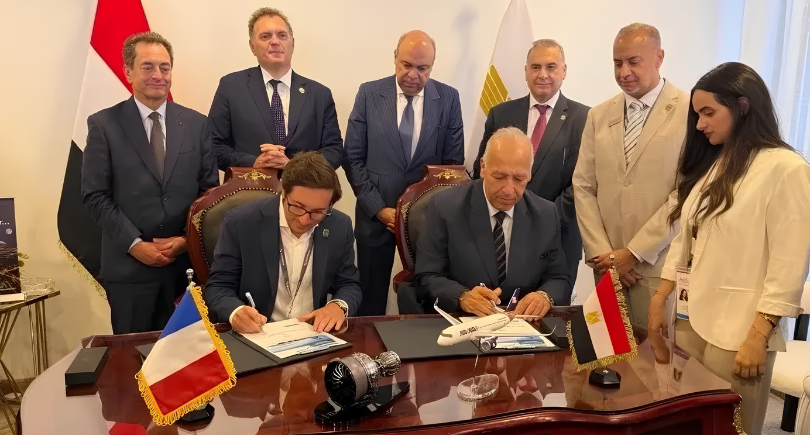

AIRCAIRO is entering a new phase of growth with two significant commitments announced at the El Alamein International Airshow 2026. The Egyptian carrier has placed a firm order for 15 Airbus A320neo aircraft, marking its first direct acquisition of aircraft from Airbus, while separately selecting CFM International LEAP-1A engines to power the new aircraft. The engine agreement includes LEAP-1A engines for the 15 aircraft, options for another 15 aircraft and spare engines, taking the potential requirement to more than 60 LEAP-1A engines.
The announcements underline AIRCAIRO’s increasingly ambitious fleet strategy as the airline moves beyond rapid expansion towards building a larger, more modern and operationally efficient fleet. With more than 45 aircraft today, compared with just seven aircraft five years ago, AIRCAIRO is targeting a fleet of more than 130 aircraft by 2034.
First direct Airbus acquisition
The 15-aircraft A320neo order represents a particularly important milestone for AIRCAIRO as it introduces direct aircraft ownership alongside its existing leased fleet. The move provides the airline with greater flexibility in managing its fleet while supporting its long-term growth plans.
Until now, AIRCAIRO has relied significantly on leased aircraft as it expanded its network. The addition of owned aircraft gives the airline another tool for managing fleet capacity, asset utilisation and long-term fleet economics.
“This agreement represents a natural next step in AIRCAIRO’s growth. Combining owned aircraft with our leased fleet gives us greater operational flexibility and financial efficiency as we scale up. The A320neo will provide the capacity needed to expand our network, serve the growing demand for travel to and from Egypt, and support the country’s aviation and tourism sectors in close partnership with Airbus,” said Hussein Sherif, Chairman & CEO, AIRCAIRO.
The A320neo will also allow the airline to continue building around a globally established single-aisle platform. With more than 20,200 orders for the A320 Family, Airbus’ best-selling single-aisle family provides AIRCAIRO with access to a mature global operating and support ecosystem.
A320neo centre of fleet modernisation
For AIRCAIRO, the A320neo is central to its plans to increase capacity while improving operating efficiency. The aircraft offers at least 20% fuel savings and CO₂ reduction compared with previous-generation single-aisle aircraft, while providing the range and flexibility required for domestic, regional and international operations.
The fleet expansion comes as AIRCAIRO seeks to strengthen connectivity from Egypt to a wider range of markets. Increased capacity will support the carrier’s network growth while allowing it to respond to rising demand for travel to and from Egypt.
“We are delighted that this first direct acquisition from AIRCAIRO reaffirms the airline’s confidence in the A320neo to power its next phase of growth,” said Benoît de Saint-Exupéry, Airbus Executive Vice President, Sales, Commercial Aircraft. “The A320neo provides AIRCAIRO with the efficiency and flexibility to scale up its network. This commitment highlights the strength of our partnership and AIRCAIRO’s confidence in the A320neo to expand connectivity between Egypt and key international destinations.”
For an airline targeting more than 130 aircraft within the next eight years, however, fleet commonality and operational efficiency will become increasingly important. A larger A320neo presence can help AIRCAIRO develop greater familiarity across flight operations, engineering and maintenance while supporting a more streamlined approach to fleet management.
CFM partnership extends into next growth
Alongside its Airbus commitment, AIRCAIRO has selected CFM International’s LEAP-1A engine for the new A320neo aircraft, reinforcing a relationship that stretches back nearly two decades.
AIRCAIRO has relied on CFM engines since 2005. Its current fleet includes 20 A320neo aircraft powered by LEAP-1A engines, as well as 12 A320ceo aircraft equipped with CFM56 engines.
The latest agreement therefore represents a continuation rather than a change in the airline’s propulsion strategy. With 15 firm aircraft, options for another 15 and spare engines included in the agreement, the potential total requirement exceeds 60 LEAP-1A engines.
“This milestone with CFM International marks a new chapter in our growth strategy,” said Hussein Sherif, Chairman & CEO of AIRCAIRO. “The LEAP-1A engine’s outstanding performance and reliability are essential for our fleet modernization efforts, enabling us to offer our passengers a best-in-class travel experience while further improving our operational efficiency.”
The continuation of the LEAP-1A platform also has implications for AIRCAIRO’s future maintenance and technical operations. As the airline expands its LEAP-powered fleet, accumulated experience with the engine family can support greater familiarity across engineering teams, maintenance planning and operational support.
Growing fleet, growing MRO requirements
AIRCAIRO’s fleet ambitions place MRO firmly within its long-term growth equation. Increasing the fleet from more than 45 aircraft today to more than 130 aircraft by 2034 will require the airline to scale its technical infrastructure alongside its aircraft.
Fleet growth translates directly into additional maintenance events, component requirements, engine shop visits, spare-engine requirements, tooling, technical records and skilled personnel. As the number of aircraft increases, so too does the need for accurate maintenance forecasting and effective reliability management.
For AIRCAIRO, the challenge will therefore be to ensure that its MRO capabilities develop at the same pace as its fleet. Maintaining high aircraft availability across a rapidly expanding operation will require strong relationships with OEMs, MRO providers, parts suppliers and other aftermarket partners.
The airline’s growing LEAP-1A fleet could provide an important degree of continuity in this area. A larger installed base of the same engine family can allow operators to build deeper technical knowledge and establish more consistent maintenance practices.
LEAP aftermarket focus
The latest CFM agreement also comes as the LEAP programme continues to mature across the global commercial aviation fleet. CFM International has delivered more than 10,000 LEAP engines to date, making it one of the fastest-ramping commercial engine programmes in aviation history.
As the global installed base expands, the focus is increasingly moving towards engine availability, time on wing and lifecycle economics. CFM is continuing to introduce upgrades designed to improve LEAP performance and reduce maintenance requirements.
Among these initiatives is a high-pressure turbine durability kit, intended to extend time on wing, as well as a reverse bleed system, designed to reduce the maintenance burden for operators.
For a fast-growing airline such as AIRCAIRO, improvements in engine durability and maintenance efficiency can become increasingly significant. Greater time on wing and reduced maintenance exposure can support aircraft availability while helping operators manage the cost and complexity associated with a growing fleet.
“This agreement with AIRCAIRO reinforces the strong partnership between our companies,” said Gaël Méheust, President & CEO of CFM International. “We are proud of AIRCAIRO’s continued confidence in CFM and remain fully committed to delivering the performance and support they have come to expect from us.”
Ownership brings asset management priorities
AIRCAIRO’s decision to combine owned aircraft with its existing leased fleet also introduces a new dimension to its asset-management strategy.
Owned aircraft allow an airline to make long-term decisions around utilisation, maintenance and asset value without the same lease-return considerations associated with leased aircraft. At the same time, ownership places greater responsibility on the operator for lifecycle management and long-term maintenance planning.
For AIRCAIRO, managing these two fleet structures together will require close coordination between commercial planning, technical operations, engineering, procurement and finance. As the owned fleet grows, maintenance decisions will increasingly need to consider not only immediate operating requirements but also long-term asset value and lifecycle costs.
This makes the development of robust technical and asset-management capabilities particularly important as the airline moves towards its 2034 fleet objective.
Building the infrastructure
AIRCAIRO’s target of more than 130 aircraft by 2034 represents a significant step up from its current operation. The airline has already demonstrated the pace at which it can expand, growing from seven aircraft five years ago to more than 45 aircraft today.
The next stage will be more complex. Scaling an airline of this size requires investment not only in aircraft but also in maintenance capacity, engineering talent, digital infrastructure, inventory management, supply-chain resilience and technical training. Ensuring that aircraft remain available as the fleet grows will become a critical measure of operational performance.
For MRO teams, this means preparing well ahead of the fleet itself. Maintenance capacity has to be planned around future utilisation, engine requirements and component demand rather than simply reacting once aircraft enter service.
The increasing role of digital maintenance planning and predictive analytics could also become important as AIRCAIRO scales. A larger fleet generates significantly more operational and maintenance data, creating opportunities to improve reliability, anticipate component requirements and optimise maintenance scheduling.
Supporting Egypt’s aviation growth
AIRCAIRO’s expansion is also closely aligned with Egypt’s broader ambitions for aviation and tourism. The additional A320neo capacity will allow the airline to expand connectivity across domestic, regional and international markets, supporting passenger growth while strengthening links between Egypt and key destinations.
For the Egyptian aviation sector, a rapidly expanding home-grown carrier also creates opportunities across the wider aviation ecosystem. Fleet growth can generate demand for maintenance services, technical talent, components, training, ground support and other aviation services.
As AIRCAIRO grows, the airline could therefore become an increasingly important contributor to Egypt’s wider aviation and aftermarket landscape.
The Road to 2034
AIRCAIRO’s latest aircraft and engine commitments represent more than incremental fleet additions. They signal the beginning of a new stage in the airline’s development—one built around a combination of owned and leased aircraft, a growing A320neo fleet and continued reliance on CFM propulsion.
The 15-aircraft Airbus order provides immediate capacity for expansion, while the LEAP-1A agreement creates continuity in the airline’s propulsion strategy. Together, they establish a foundation for AIRCAIRO’s next phase of growth.
The bigger test, however, will be ensuring that the infrastructure supporting the aircraft expands at the same speed.
With a target of more than 130 aircraft by 2034, AIRCAIRO will need to build not only a larger fleet but also a stronger technical organisation, resilient supply chains, deeper MRO partnerships and a workforce capable of supporting a substantially larger operation.
For an airline that has grown from seven aircraft to more than 45 in just five years, the trajectory is already clear. AIRCAIRO is no longer simply expanding its fleet; it is building the foundations of a significantly larger aviation operation. And for the MRO sector, that makes its next eight years particularly worth watching.