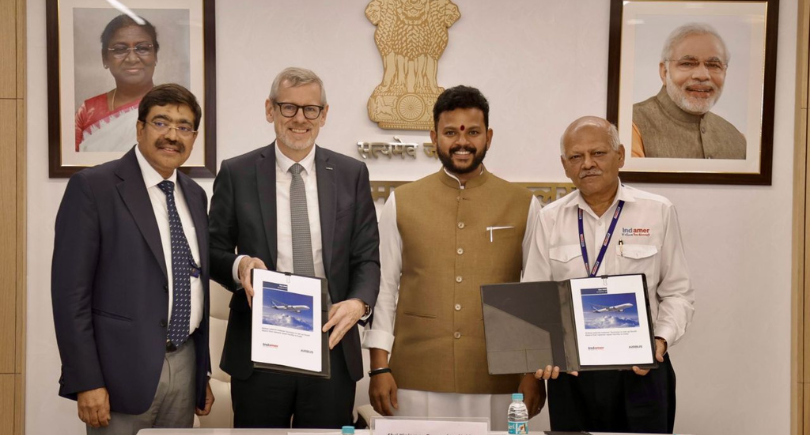

The Nagpur facility is expected to bring specialised radome repair closer to Indian operators, reducing overseas shipments, cutting turnaround times and strengthening domestic MRO capabilities
Airbus is strengthening its commitment to India’s growing aviation MRO ecosystem by selecting Indamer Technics to establish South Asia’s first radome repair facility in Nagpur, Maharashtra. The facility will enable radomes to be repaired within India instead of being sent overseas, helping airlines and other aircraft operators reduce maintenance turnaround times and improve aircraft availability.
The development represents another step in India’s efforts to build a stronger domestic MRO ecosystem, particularly in specialised maintenance capabilities that have traditionally depended on overseas facilities.
Bringing specialised repairs closer to operators
A radome may appear to be a relatively small part of an aircraft, but it plays an important role. Located at the nose of the aircraft, the structure protects the weather radar and other equipment while allowing radar signals to pass through.
Damage to a radome can therefore require specialised inspection and repair to ensure that both the structure and the equipment behind it continue to function properly.
Until now, Indian operators requiring certain specialised radome repair services have had to rely on overseas facilities, adding transportation, logistics and additional time to the maintenance process. The new Nagpur capability is expected to change that equation.
By bringing the repair capability closer to Indian operators, Airbus and Indamer Technics aim to reduce turnaround times and help aircraft return to service more quickly.
For airlines operating growing fleets, every day an aircraft spends on the ground has an operational and financial cost. Localising specialised repair capabilities can therefore have a direct impact on fleet availability.
Why Nagpur matters
The choice of Nagpur is also significant. Nagpur has been developing as an important aviation and MRO location, supported by its central geographical position and growing aviation infrastructure. For an MRO facility, location can be particularly important because components often need to move quickly between airlines, maintenance centres and specialist workshops.
A specialised facility in central India could potentially provide easier access to operators across different parts of the country while strengthening Nagpur’s position as an emerging MRO hub. The development also fits into India’s wider ambition to increase the amount of aircraft maintenance work carried out domestically.
Another piece of India’s MRO puzzle
India’s commercial aviation fleet is expected to expand substantially over the coming years, creating demand not only for large-scale airframe and engine maintenance but also for specialised component and structural repair capabilities. This is where developments such as the Indamer facility become important.
Building a competitive MRO ecosystem is not simply about having large hangars capable of accommodating aircraft. It also requires a network of specialised workshops, component repair facilities, engineering expertise, trained technicians and supply-chain capabilities that can support aircraft throughout their lifecycle. Radome repair is one such specialised capability.
By establishing it locally, India can retain more maintenance activity within the country while potentially reducing logistics costs and aircraft downtime for operators.
Building on the Airbus-Indamer relationship
The new facility also builds on an existing relationship between Airbus and Indamer Technics. Indamer already provides MRO services for Airbus Helicopters from facilities in Mumbai, New Delhi and Nagpur. The expansion into radome repair therefore represents an opportunity to deepen that relationship and broaden Indamer’s capabilities within the Airbus ecosystem.
For Indamer, gaining the capability to undertake specialised radome repairs could also strengthen its position in India’s increasingly competitive MRO market. As more airlines and aircraft enter the Indian market, specialist capabilities can become an important differentiator for MRO providers.
A boost for ‘Make in India’
The development comes as India continues to focus on reducing its dependence on overseas maintenance facilities. Airbus has positioned support for the growth of an indigenous MRO industry as an important part of its broader commitment to India’s aviation ecosystem. The radome facility contributes to that objective by keeping a specialised maintenance activity within the country. The benefits could extend beyond the immediate repair capability.
Local MRO capacity can support skilled employment, technical training, engineering development and the growth of local aviation supply chains. Over time, the development of multiple specialist capabilities can help India move towards a more complete aviation aftermarket ecosystem rather than relying primarily on overseas providers for complex repairs.
Timing becomes increasingly important
The timing of the development is particularly relevant as Indian airlines prepare for significant fleet expansion. India is one of the world’s fastest-growing aviation markets, with carriers placing large aircraft orders to meet rising passenger demand. As the fleet grows, the volume of maintenance work will increase accordingly. This will put pressure on India’s existing MRO infrastructure and make local capacity increasingly important. The challenge will not simply be to build additional hangar space. The industry will need to develop deep technical capabilities across multiple components and systems.
The new radome facility is therefore a relatively specialised development, but strategically it represents something much larger: another building block in India’s effort to establish itself as a serious global MRO destination.
The bigger MRO opportunity
For Indian airlines, local radome repair could mean fewer overseas shipments, shorter maintenance cycles and potentially improved aircraft availability. For Indamer, it provides an opportunity to expand its specialised MRO portfolio. For Airbus, it strengthens its support for customers in one of its most important growth markets.
And for India, it represents another step towards building an MRO ecosystem capable of supporting a rapidly expanding commercial aviation fleet. The success of India’s MRO ambitions will ultimately depend on how quickly such specialised capabilities can be developed alongside large-scale airframe, engine and component maintenance.
South Asia’s first radome repair facility may address one specific maintenance requirement, but its significance is much broader, it is another step towards keeping more of India’s aircraft maintenance activity at home.