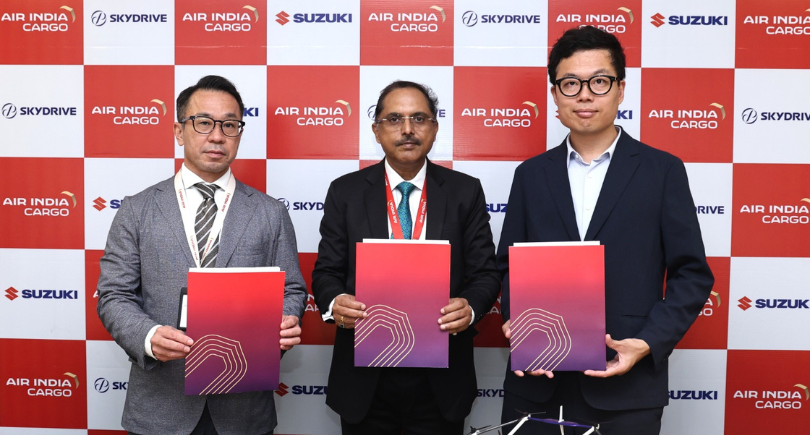

India’s aviation sector is preparing for another technological shift as Air India, Japanese eVTOL developer SkyDrive and Suzuki Motor Corporation have signed a Memorandum of Understanding (MoU) to jointly study the feasibility of using electric Vertical Take-Off and Landing (eVTOL) aircraft for medical air logistics across the country.
While the announcement is centred on emergency healthcare logistics, its significance extends far beyond the medical sector. The collaboration represents one of the first structured efforts to evaluate commercial eVTOL operations in India and could lay the foundation for an entirely new segment of the country’s aerospace industry, creating opportunities in manufacturing, maintenance, certification, pilot training, digital operations and aftermarket support.
Medical Logistics as the first commercial use
Unlike many global eVTOL projects that are focused primarily on urban passenger mobility, the Air India-SkyDrive-Suzuki partnership has chosen medical logistics as its initial application.
India’s major metropolitan cities continue to struggle with severe road congestion, making the transportation of organs, blood units, vaccines, medicines and other time-sensitive medical supplies increasingly difficult. Even delays of a few minutes can affect patient outcomes during organ transplantation, trauma care and emergency treatment.
The feasibility study will examine whether eVTOL aircraft can provide a faster, safer and more reliable solution for transporting critical medical cargo between hospitals, airports and healthcare facilities.
By beginning with medical logistics rather than passenger transport, the partners are targeting a mission-critical application where the value proposition is based on saving time and improving healthcare delivery.
New opportunities for India’s MRO sector
While much of the discussion around eVTOL aircraft focuses on urban mobility, the long-term implications for the Maintenance, Repair and Overhaul (MRO) industry are equally significant.
Every commercial eVTOL fleet will require scheduled inspections, battery health monitoring, electric propulsion maintenance, avionics support, software updates, structural repairs and component replacement throughout its operational life.
Unlike conventional aircraft powered by gas turbine engines, eVTOLs introduce new maintenance disciplines centred around electric motors, battery systems, power electronics, thermal management systems, autonomous flight technologies and advanced composite airframes.
This will require Indian MRO organisations to develop entirely new technical capabilities, specialised tooling and digitally enabled maintenance processes.
As fleet sizes grow over the next decade, eVTOL maintenance could emerge as a specialised business segment within the broader aerospace aftermarket.
Certification challenge
One of the biggest hurdles facing the industry is certification. Unlike traditional aircraft, eVTOLs combine elements of rotorcraft, fixed-wing aircraft, electric propulsion and highly integrated digital flight control systems.
Regulators, including India’s Directorate General of Civil Aviation (DGCA), will eventually need certification frameworks covering aircraft airworthiness, maintenance programmes, continuing airworthiness management, technician licensing, battery safety and operational procedures.
The development of these regulatory standards will be critical before commercial services can begin.
Infrastructure
While public attention often focuses on vertiports, the industry’s infrastructure requirements are considerably broader. Commercial eVTOL operations will require dedicated maintenance facilities, battery charging and storage systems, spare parts warehouses, digital monitoring centres, logistics support, maintenance planning software and trained technical personnel.
OEMs and operators will also require approved repair organisations capable of supporting airframe maintenance, propulsion systems and avionics throughout the aircraft lifecycle.
For India’s MRO industry, this represents an opportunity to participate from the early stages of ecosystem development rather than adapting later.
Also Read – Sarla Aviation Completes Sylla Flight Test Campaign
Why Japan is looking at India
Japan has become one of the world’s leading developers of advanced air mobility technologies. SkyDrive has been developing eVTOL aircraft for several years, while Suzuki has been supporting the programme through manufacturing collaboration and industrial expertise.
India offers a compelling market due to its rapidly expanding aviation sector, increasing urbanisation, strong engineering talent and government initiatives supporting advanced manufacturing.
Rather than simply exporting aircraft into India, Japanese companies appear to be evaluating long-term industrial partnerships that could eventually include manufacturing, maintenance, technical training and local supply chain development.
Air India‘s role
For Air India, the collaboration reflects a broader strategic interest in advanced air mobility rather than simply participating as an airline. The carrier brings extensive experience in airport operations, cargo handling, route planning, regulatory engagement and aviation safety.
Its participation provides operational expertise that will help evaluate how eVTOL aircraft could be integrated into India’s existing aviation ecosystem while maintaining safety, reliability and regulatory compliance.
The study may also offer valuable insights into future cargo operations that complement conventional airline networks.
Aftermarket potential
Although the current agreement is limited to a feasibility study, it highlights the emergence of an entirely new aftermarket opportunity.
Global forecasts suggest that advanced air mobility will create demand not only for aircraft manufacturing but also for long-term maintenance contracts, battery lifecycle management, predictive maintenance software, digital fleet monitoring, component repair, training services and spare parts distribution.
For Indian MRO providers, early participation in this evolving sector could provide a first-mover advantage as operators begin introducing commercial eVTOL fleets over the coming decade.
The MoU does not signal the immediate launch of eVTOL services in India. Significant work remains in certification, infrastructure development, regulatory approvals and commercial validation.
However, by bringing together an airline, an eVTOL manufacturer and an established automotive company, the partnership represents an important milestone in India’s advanced air mobility journey.
For the aviation aftermarket, it also raises an important question: as eVTOL aircraft move from concept to commercial reality, is India’s MRO industry prepared to support an entirely new generation of aircraft?
The answer will shape not only the future of advanced air mobility but also the next phase of growth for India’s aerospace maintenance ecosystem.