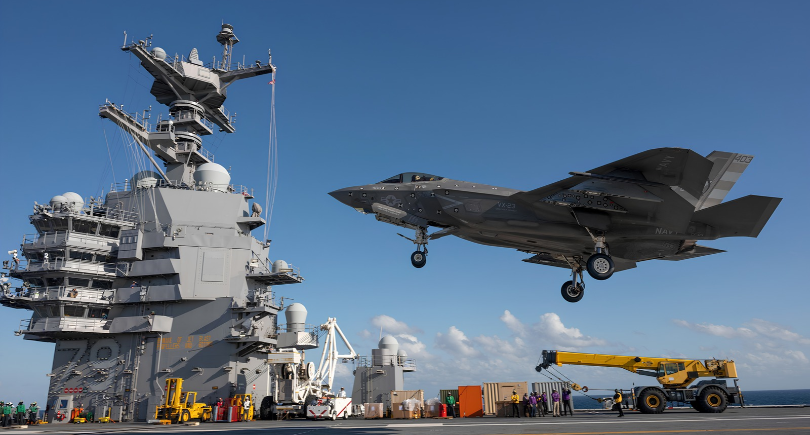

Lockheed Martin’s F-35C Lightning II has completed its first shipboard launch and recovery tests aboard a Gerald R. Ford-class aircraft carrier, marking a milestone in the integration of the fifth-generation fighter with the US Navy’s latest carrier platform.
Two F-35C aircraft from Naval Air Station Patuxent River, Maryland, conducted 11 days of testing aboard the PCU John F. Kennedy (CVN 79). The trials involved 34 flights, 122 catapult launches, and 122 arrested landings using the carrier’s Electromagnetic Aircraft Launch System (EMALS) and Advanced Arresting Gear (AAG).
The testing assessed the aircraft’s compatibility with the Ford-class carrier’s flight deck and its launch and recovery systems. The class features EMALS for aircraft launches, AAG for arrested recoveries, and a redesigned flight deck and island that introduce different airflow, exhaust, and deck operating conditions.
“This is a critical event for the F-35C, Kennedy, and the United States Navy,” said Sean Jackson, vice president of Lockheed Martin’s F-35 Development Program. “For the first time, the aircraft has demonstrated launch and recovery operations from a Gerald R. Ford-Class flight deck, advancing the integration of fifth-generation fighter capability with the world’s most advanced carrier technology. With the completion of this test phase, the Navy has now cleared the F-35C for operations across its entire fleet of aircraft carriers.”
Testing Validates Aircraft and Carrier Systems
The sea-based trials followed shore-based testing conducted between January 2024 and May 2025. The integrated test team collected data to verify EMALS and AAG software and shipboard installations, as well as validate the F-35C’s structural and load models during launch and recovery.
The programme also supported the development of Aircraft Launch Bulletins and Aircraft Recovery Bulletins for Ford-class carriers. These documents provide operational guidance for launching and recovering aircraft from the carrier.
Also Read – Safran expands landing gear MRO and component repair capabilities across Asia-Pacific
Testing further assessed the stability of the F-35C’s mission systems software, including initial use of Block 4 software in a carrier environment, and evaluated aircraft supportability aboard the new platform.
The successful trials provide data for the integration of the F-35C with the Navy’s next-generation carriers and support its future operational deployment. The aircraft combines stealth characteristics, advanced sensors, and data-sharing capabilities for carrier-based and joint-force operations.