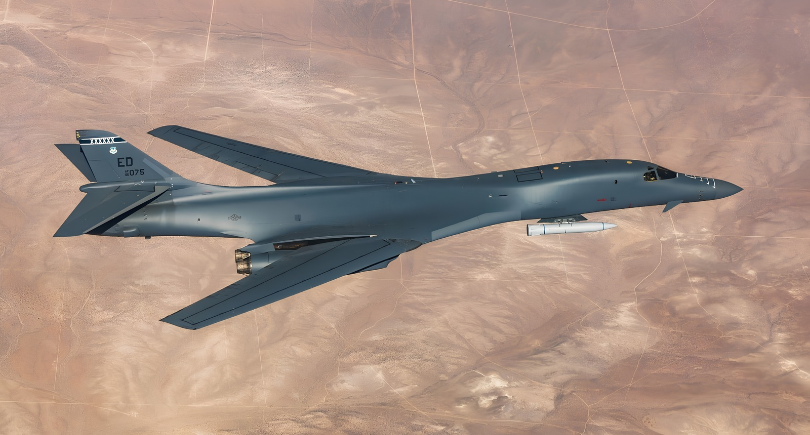

Boeing’s Load Adaptable Modular (LAM) pylon for the B-1 bomber has cleared critical design review (CDR), advancing the external carriage system toward manufacturing preparation, integration, and testing. The milestone brings the US Air Force bomber closer to a new capability designed to expand its payload capacity and support future weapons.
The LAM pylon is being developed to enable the B-1 to carry external payloads using six existing hard points originally designed for the Air-Launched Cruise Missile. The system could expand the aircraft’s ability to accommodate advanced munitions, including hypersonic weapons, and provide greater flexibility for evolving mission requirements.
According to Boeing, the completed CDR confirms that the system design is sufficiently mature to proceed to the next stage of development. Boeing and the US Air Force have agreed to move forward with the work required to build and test the system, with the US Air Force B-1 program office establishing the design’s product baseline.
The new external carriage capability could potentially double the B-1’s payload capacity, supporting efforts to keep the bomber operationally relevant through 2040 and beyond as the US Air Force continues modernizing its bomber fleet.
Boeing B-1 program manager Lynsay Brannock said the milestone marks a transition from design work to preparing the solution for production and testing. Dan Ruder, Bombers Advanced Programs manager, said the pylon would give commanders additional options by supporting advanced weapons and other payload types.
Also Read – Greece orders three KC-390 Aircraft
The concept originated with Boeing’s Oklahoma City B-1 team, led by engineer Tristin Lam, under the company’s independent research and development (IR&D) program. The initiative enabled Boeing to develop the concept and retain the intellectual property before the US Air Force formally requested the capability.
With the design review completed, the program moves closer to hardware development and testing as Boeing continues working toward expanding the B-1’s mission capabilities.